Two Months Until Our 6-Month Latin America Trip – What’s Done and What’s Left to Do?
Today marks exactly two months until we leave.
On the one hand, it feels like we still have all the time in the world. On the other, it suddenly feels like we’re leaving tomorrow and there’s still so much left to do.
We’ve already spent several months planning our six-month trip through Latin America, and most of the route is now in place. Despite everything that’s still left to do, I’m incredibly excited and already looking forward to the adventure ahead.
If you’re reading this wondering why anyone would decide to disappear to Latin America for half a year – and, perhaps more importantly, where we got the money to do it – we sold our home so we could slow down and step away from our everyday routine for a while.
At first, we thought we would figure things out as we went. At some point, though, I realised that from a safety perspective I’d feel much better having a clearer plan before we left.
I’m also simply the kind of person who needs to know at least where I’m going to sleep tomorrow night if I want any sort of peace of mind. Being spontaneous every now and then is great. Being completely spontaneous for six months? Personally, not for me.
How to Plan Travelling for 6 Months?
I started planning the trip by looking for flights.
For a couple of weeks, I compared one-way fares from Tallinn to different major cities across Latin America. Eventually, the best option turned out to be a Tallinn–Bogotá flight with a connection in Zurich. Our one-way tickets for two cost €1,152.70.
Once the flights were booked, the serious Googling began: what to do, where to stay, how safe different areas are, and so on.
I found countless travel blogs that gave me ideas for places to visit in Colombia. At some point, though, I realised that simply reading everything wasn’t enough. There was no way I was going to remember all of that information.
So I started using ChatGPT to help with the planning, opened a blank Word document alongside it and began writing everything down: where we would stay, how we could get there, how much things would cost and so on.
It didn’t take long to realise just how much time this kind of long-term travel planning takes, and that it made sense to plan the overall journey in advance. That way, the decisions we’ll make on the road can be things like which tour to take or what we feel like doing that day – rather than trying to figure out where we’re going next or where we’ll sleep tomorrow night.
By now, the basic framework of the trip is in place. We know our route and roughly when we’ll be back in Estonia.
Most of our flights and accommodation are now booked all the way through to Peru, our final destination in Latin America. I already have an idea of where I want to travel home from, but I’m not revealing that part just yet.
I’m also not going to list every country we’ll visit along the way. There has to be at least a little bit of suspense left.
I haven’t booked any buses, shuttles or transfers yet because there’s little point in booking most of them this far in advance. I do have notes on how we should be able to get from one destination to the next, but we’ll deal with the actual bookings as we go.
We deliberately planned the itinerary so that we wouldn’t spend every day rushing from one place to another. We want time to actually enjoy where we are and, whenever possible, avoid changing accommodation every day.
Our travel style won’t be the cheapest possible backpacking trip, but we won’t be staying in luxury hotels either. Somewhere in between. Sometimes we’ll stay in hostels, sometimes in private apartments with a washing machine and a proper kitchen.
And somewhere around halfway through planning Colombia, I discovered something else: there are a lot of frogs in this part of the world.
For me, this is actually quite a problem because I have a serious frog phobia. I can’t even explain why, and I’ve been working on it quite a lot, but when booking accommodation I’ve still tried to choose places where the chances of finding frogs inside the room or on the terrace seem relatively low.
We’ll see how successful that strategy turns out to be in real life.
What Is Our 6 Month Travel Budget?
One major advantage of planning the trip in advance is that I can put together a fairly accurate 6 month travel budget.
There is one thing that frustrates me about many of the travel blogs I’ve read: surprisingly few people actually say how much their trip cost.
I’ve decided to be completely open about how much we spend on ours.
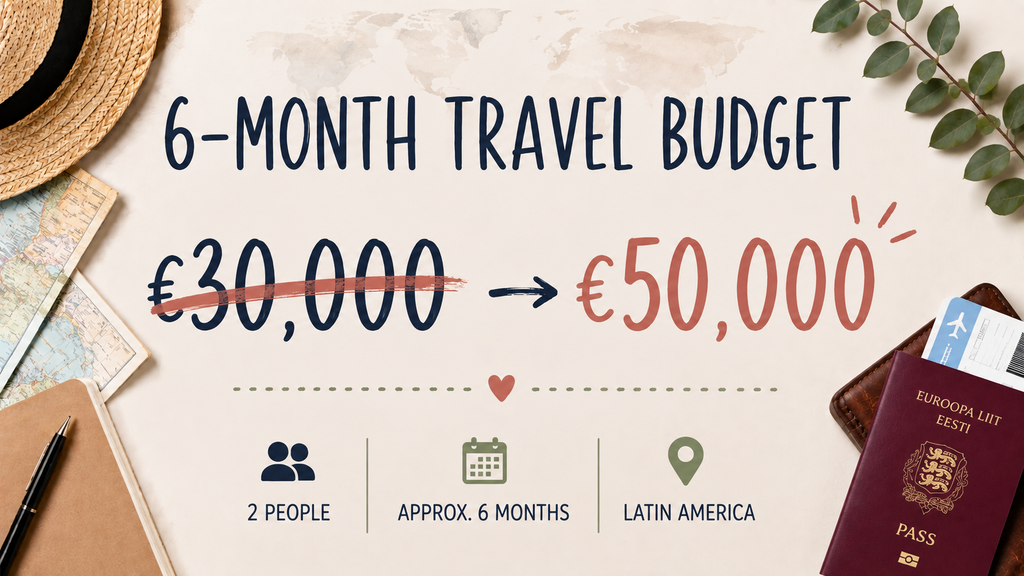
Our original plan was to spend no more than €30,000. Halfway through planning, I realised that simply wasn’t going to be enough.
If we had wanted to stay strictly within that original €30,000 budget, we would either have had to shorten the trip to keep the travel style we wanted, or choose considerably cheaper accommodation and skip a lot of the activities we want to experience.
I didn’t want to do either, so I decided to increase the budget.
I understand that to some people this might sound like an absolutely ridiculous amount of money to spend on travelling. But I know myself. I have never regretted a single euro I’ve spent on travel.
Money comes and goes. The experiences and memories we’ll get from this trip will stay with us for the rest of our lives.
The worst thing that can happen when we come home is that there’s nothing left of the money from selling our house and we have to go straight back to work.
Isn’t that basically everyday life for most people anyway?
When you look at it that way, the worst-case scenario doesn’t seem particularly terrifying.
So our new travel budget is €50,000.
The flights have already been paid for. So has our San Blas trip in Panama over Christmas. Almost all of our accommodation can still be cancelled for free.
With our Airbnb bookings, payment is usually due a few weeks before arrival. With our Booking.com reservations, some stays are paid at the property while others are charged before arrival.
Whenever I had the option, I deliberately chose not to pay for accommodation immediately. Until the payment is actually due, I’d rather have that money sitting in an interest-bearing savings account than tied up in bookings months in advance.
I still hope we’ll manage to spend less than €50,000, but we’ll find out along the way. And as I said before, I plan to be just as open afterwards about what the trip actually ended up costing us.
Passports, Visas and Other Paperwork
Whenever people write about preparing for a long trip, one of the first pieces of advice is usually to check the expiry date on your passport.
I’ll be honest: I’ve never actually done that before travelling because I always know exactly when mine expires. Mait’s passport and mine were issued on the same date, so I know when his expires too. And I’ve somehow managed to remember both dates for years.
When choosing the countries for our route, I also made sure that, as Estonian citizens, we wouldn’t need to apply for visas in advance.
Visa and entry requirements vary depending on your nationality and can change, so it’s always worth checking official government or embassy information for every country on your itinerary rather than relying on old blog posts or social media.
There was actually only one country on my original list where the entry requirements seemed like they might require a little more effort: Nicaragua.
It wasn’t exactly a dream destination for me, so in the end I didn’t even bother figuring out how complicated it would be. I simply removed it from our route.
We have copies of our passports saved in Gmail, and I’ll probably take printed copies with us as well.
I still haven’t decided where to save all of our accommodation information so we can access it offline. I’m also undecided about whether I should download some areas in Google Maps for offline use.
Because we’re planning to activate our Global eSIM before we even leave Estonia – and Estonia itself is one of the covered destinations – we should, in theory, have internet access most of the time. Of course, there will be places in Latin America where mobile coverage is limited or nonexistent. I just haven’t decided yet whether that’s enough of a reason to make all of our accommodation and transport information available offline as well.
If you’ve travelled long-term and have experience with this, I’d genuinely love to hear what worked for you.
Travel medicine consultation
Before planning this trip, I had never even heard of such a thing as a travel medicine consultation. Since our trip will last a little over six months and we’ll be visiting quite a few different destinations, I started looking into which vaccinations might be worth getting well in advance.
It soon became clear that the yellow fever vaccine was one we should definitely consider. Yellow fever is present in some of the places we’ll be visiting, and certain countries may also require proof of vaccination if you arrive from an area where yellow fever is considered a risk.
I called West Tallinn Central Hospital in Tallinn in mid-July to book an appointment for Mait and me. The first available appointment was on 1 September. It’s a paid service, and the consultation fee for two adults attending together was €90.
One thing I would definitely recommend to anyone planning a longer trip is booking a travel medicine consultation well in advance. I called in mid-July and our first appointment wasn’t until a month and a half later. Some vaccines also can’t simply be left until the last minute. For example, the international yellow fever vaccination certificate only becomes valid ten days after vaccination.
Finding the right department turned out to be more of a challenge than expected, but once we got there, the doctor was very friendly and helpful. I told her about our plans, the countries we’ll be visiting and some of the diseases I had already read about through other travellers’ experiences. She also gave us plenty of useful information about what to take with us, what to be aware of in different regions and which vaccinations might be worth considering for our particular route.
Since we still have some time before departure, we put together a vaccination plan during the first appointment and decided to take a little more time to think about a few of the vaccines.
On 1 September, we both received the yellow fever vaccine, which cost €50 per person, and a hepatitis A vaccine for €40 per person. We were also given an international vaccination certificate – the small yellow booklet often referred to simply as the yellow card – which will probably become almost as important a travel companion as our passports.
I had already had one dose of the hepatitis A vaccine in the past, so this second dose completed my vaccination course. My vaccination certificate now quite literally says “for life”, so as far as I’m concerned, hepatitis A is one less thing to think about.
The yellow fever vaccine is similar in that one dose is generally enough, and the international vaccination certificate is valid for life from the tenth day after vaccination. According to the WHO, a single dose provides lasting protection and routine booster doses are not normally needed. There is also no specific treatment for yellow fever, which makes vaccination particularly important when travelling in risk areas.
The doctor warned us that some people may develop a high fever and feel quite unwell a few days after the yellow fever vaccine, although this should pass fairly quickly.
The very next day, I noticed that my tonsils were extremely swollen and covered in white patches, and I also had a headache. I didn’t have a fever, cough or runny nose, and by now my tonsils are almost completely back to normal. From what I could find about possible side effects, the headache could have been related to the vaccines, but swollen tonsils with white patches aren’t considered a typical reaction. So I still have no idea whether I actually had any vaccine side effects at all, or whether something completely unrelated just happened at exactly the same time. Mait felt absolutely fine.
Our first travel medicine appointment, including the consultation and two vaccines each, cost us €270 in total.
There is also a risk of malaria in some of the areas we’ll be visiting. Malaria vaccines do exist nowadays, but they are mainly used to protect children living in malaria-endemic areas and are not normally given to travellers. Travellers may instead be advised to take preventive medication as well as precautions against mosquito bites.
The doctor prescribed 24 malaria tablets for each of us.
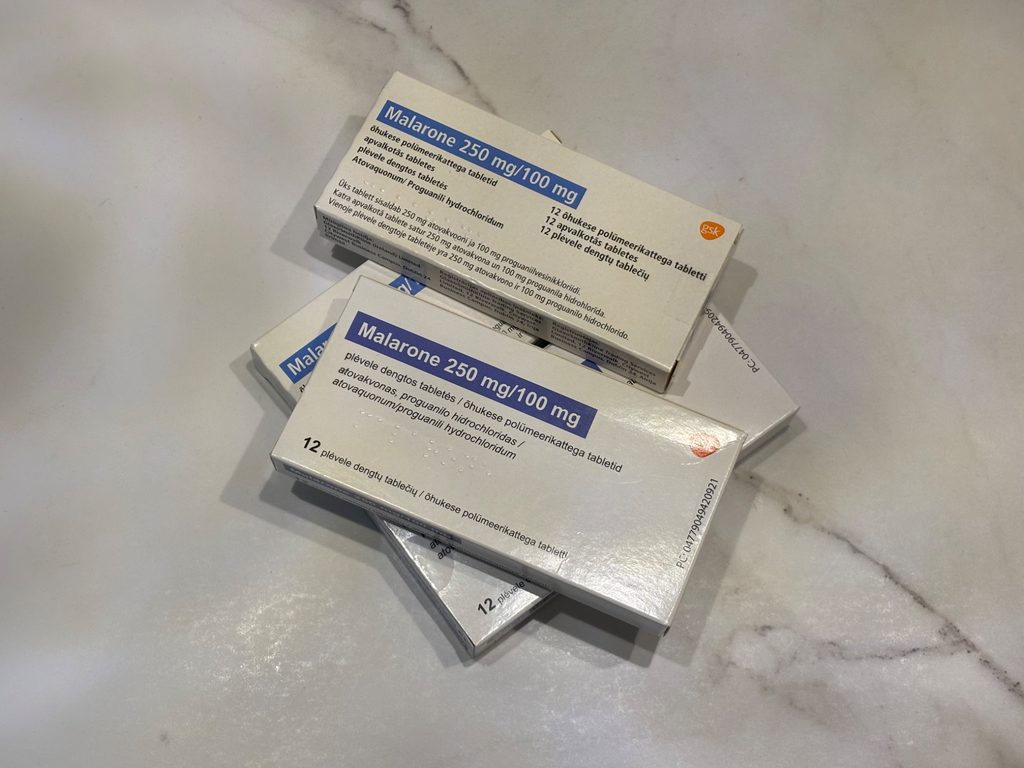
My understanding of the doctor’s instructions was that we should start taking them one day before entering a malaria-risk area, continue throughout the entire time we are there, and then keep taking them afterwards for the same number of days we had spent in the risk area.
That last part, however, doesn’t match the instructions that come with the medication. The standard preventive schedule for the atovaquone/proguanil we were prescribed is to start taking it 1–2 days before entering a malaria-risk area, take it every day while there, and continue for another seven days after leaving. So I’ll definitely clarify this with the doctor at our next appointment.
The tablets were fairly expensive and surprisingly difficult to find. I managed to get enough for my prescription from a pharmacy in Tapa, the small town where we live, but had to go to nearby Rakvere to find enough for Mait’s prescription. Four boxes, or 48 tablets in total, cost €119.26.
Whether malaria prevention medication is needed at all, and in which specific areas, depends on your exact itinerary, so it’s definitely something worth discussing with a doctor before travelling.
Our next appointment is booked for 29 September. That’s when we’re also going to discuss the high-altitude parts of our trip and whether the doctor recommends taking any medication with us for those. We’ll also get a combined diphtheria and tetanus vaccine, and there was one other vaccine that sounded sensible when the doctor explained it to me, but I have completely forgotten which one it was.
I still haven’t made a final decision about the rabies vaccine either, although at the moment I’m leaning towards not getting it.
Money While Travelling – Bank Cards and Cash
One thing I normally don’t do before a trip – but did this time – was check the expiry dates on our bank cards.
Both of our Estonian bank cards were renewed in July, so we’re good to go. We don’t plan to use them as our everyday cards while travelling, but it’s good to have them as backups.
After reading a mix of Estonian and international travel blogs, I decided that we’ll use Revolut and Wise as our main travel cards instead.
I chose Revolut Premium for myself, which costs €10.99 per month. Revolut also gives you RevPoints on eligible purchases, which can be used for things like airline miles and other travel-related rewards.
Since getting the card, I’ve been using it for all of our travel bookings as well as quite a few everyday purchases.
Premium also comes with several benefits that are useful while travelling. There is no monthly fair-usage limit on currency exchange and no additional weekend exchange fee. I can also withdraw up to €400 per month from ATMs without Revolut charging its own withdrawal fee. The ATM operator can still charge a separate fee, though, which is worth keeping in mind.
Mait is sticking with the free Revolut plan for now. We’ll decide later whether there’s any reason for him to upgrade to Premium as well.
Wise doesn’t have a monthly or annual subscription fee, and the physical card cost €4 when I ordered mine. For customers in the European Economic Area, Wise also pays variable monthly cashback on eligible balances held in euros, British pounds and US dollars.
Personally, I prefer to keep most of our travel money in Swedbank’s Rahakoguja, which is essentially an interest-bearing savings account offered by our Estonian bank. The biggest advantage for me is that the money isn’t directly accessible through any of our bank cards.
My approach is to keep only as much money in our card-linked accounts as we actually need and leave the rest separate. That way, if a card goes missing or its details somehow end up in the wrong hands, our entire travel budget isn’t sitting there ready to be spent in one go.
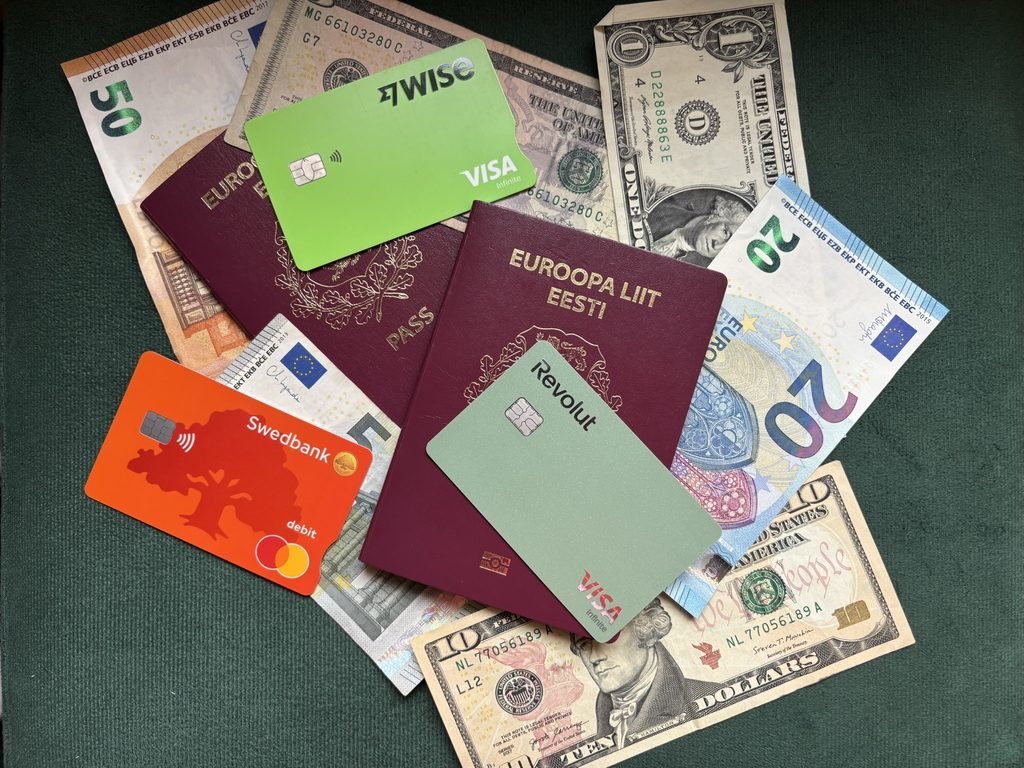
As important as bank cards are, cash will be just as important – and in some places probably even more so. Cash is still widely preferred in many of the destinations we’re visiting.
We’ll definitely take some euros with us, but US dollars are considerably more useful in several of the countries on our route. So we’re planning to exchange some dollars in Estonia before we leave, enough to cover at least the first few days.
I haven’t decided on the exact amount yet. I still need to work out how much cash makes sense to carry at one time.
We lost a fairly significant amount of cash during our trip to the Dominican Republic, so that experience has definitely made us more cautious.
Actually, we learned a lot from that trip in general, and many of those lessons have been surprisingly useful while planning this journey through Latin America.
Travel Insurance is Still Undecided
One of the most important things we still need to sort out two months before departure is travel insurance.
Because the trip is so long and we don’t yet know exactly when we’ll be back in Estonia, many standard travel insurance policies simply don’t work for us.
Insurance included with bank cards also tends to limit the maximum length of a single continuous trip, and the policies included with our cards don’t cover a journey this long.
At the moment, I’ve narrowed the options down to two providers: Genki and SafetyWing. I haven’t made the final decision yet.
If you have personal experience with either of them – or know of another option that genuinely works for a six-month trip – I’d love to hear about it.
Internet For Six Months
Another thing we need to decide before leaving is which eSIM to use.
At the moment, I’m leaning heavily towards the Saily Ultra Plus plan. It costs $59.99 per month at the regular price and includes 30 GB of high-speed data. Once that runs out, you can continue using unlimited data at speeds of up to 1 Mbps.
The plan works across 121 destinations, which makes it seem like one of the most convenient options for a trip this long.

If you haven’t used Saily before and need mobile data for an upcoming trip, you can use my code MERILY to get $5 off your first purchase. If you’re paying in euros, the discount is €4.45.
I also receive a small reward for every new user who signs up through my code.
How Do You Pack for Six Months in a 40L Backpack?
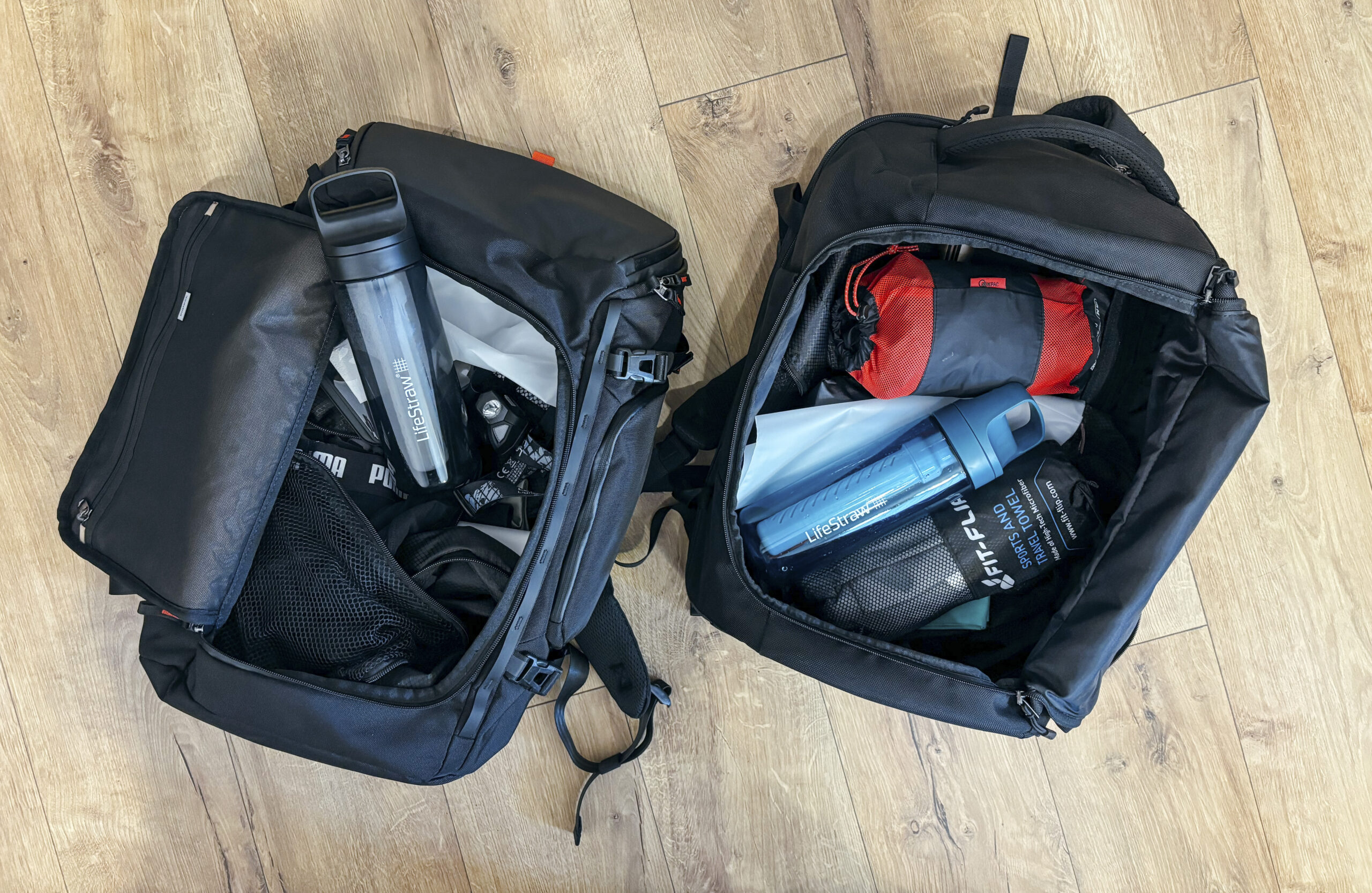
Even before buying our flights, we had decided that we wanted to do this trip with backpacks.
Moving from place to place is much easier with a backpack than with a large, bulky suitcase. It can also make domestic flights and flights between countries in Latin America cheaper because we don’t have to keep paying for checked luggage.
And there’s one more advantage: we don’t have to worry about our luggage getting lost somewhere along the way.
That meant we first had to find the right backpacks. A regular everyday backpack is a little too small for six months of travelling and not particularly practical either.
So I went back to Googling and watching reviews on YouTube.
The Osprey Farpoint 40L came up again and again, and people seem to absolutely love it. I have to admit, though, that I simply didn’t like how it looked.
Maybe I’ll change my mind in the future, but after quite a lot of research and discussion with AI, I ordered a tomtoc 40L backpack from Amazon. It cost €79 at the time.
Mait chose an Inateck 40L backpack, which also cost €79.
Essentially, our entire lives for the next six months need to fit inside those two bags.
I read a lot of long term travel tips and packing advice, watched plenty of videos and thought about what I’ve learned from previous trips.
For example, I ordered a 70 × 140 cm microfibre towel for each of us.
Most of the places we’re staying provide towels, but there will definitely be situations where having our own will be useful. I chose microfibre rather than a normal cotton towel because it dries much faster and takes up significantly less space when packed.
When everything has to fit into a 40L backpack, every bit of space matters.
Many of our booked apartments have a washing machine, and some even have a dryer. But there will also be times when we’re staying in very basic hostels.
So what happens when we wash our clothes and have nowhere to dry them?
I spotted a retractable clothesline on another travel blogger’s packing list and found one on Amazon that rolls up almost like a measuring tape. It even came with 20 tiny clothes pegs.
Another thing I had never even heard of before planning this trip was a water bottle with a built-in filter.
A lot of travellers recommended one for destinations where tap water isn’t safe to drink. After doing some research, I chose the plastic LifeStraw Go Series bottle. I personally think stainless-steel bottles can give water an unpleasant taste, while a glass bottle would be heavier and therefore less practical for travelling.
The bottle comes with a membrane microfilter that removes bacteria including E. coli and salmonella, parasites, microplastics, sand, dirt and cloudiness from the water.
It also has an activated carbon filter that reduces chlorine and unpleasant odours and improves the taste of the water.
The carbon filter lasts for up to 100 litres, or roughly two months, so I ordered replacement filters to take with us. The main membrane filter lasts for up to 4,000 litres, which the manufacturer estimates at around five years of daily use.
One important limitation is that the Go Series is a water filter rather than a purifier, so it does not remove viruses. In places where viral contamination is a concern, LifeStraw recommends using an additional purification method.
The closer we get to departure, the longer the list of things we “definitely need” seems to become – while our entire lives for the next six months still have to fit into two 40L backpacks.
I already suspect the first time we try to actually pack all of this is going to be interesting.
But the Trip Isn’t the Only Thing We Need to Sort Out Before November
While all of this planning is happening, normal life hasn’t exactly stopped.
Before we leave, we want to finish renovating an apartment that has been sitting unfinished for quite a while for various reasons and put it up for sale.
Mait finished the last outstanding furniture jobs in August, and today the final order is being installed. For now, we’re no longer taking on any new orders. We also needed to empty the workshop and put all of the tools and equipment into storage.
Luckily, we already moved most of our personal belongings into storage after selling our house, so our current living space contains only the things we actually need. Some of those will come travelling with us, and the rest will go into storage as well.
I still haven’t decided exactly when I’ll stop working, but I’m thinking sometime around the middle of October.
That should leave enough time to put the last few things into storage and, more importantly, see everyone close to us one more time and say goodbye before we leave.
Two Months to Go
When I think about this trip now, it feels strange to realise that two months from now, our normal routine will basically no longer exist.
Every week will bring a new place, a new environment and something new to discover.
I’m incredibly excited about the adventure ahead and, right now, it feels like this will probably be our once-in-a-lifetime trip.
There are things that don’t worry me at all. For example, the fact that there might occasionally be no internet.
But there are also things where the uncertainty makes a planner like me slightly nervous. For example, I still don’t know exactly how we’ll arrange all of our transport between cities once we’re there.
Neither Mait nor I speak enough Spanish to communicate comfortably either.
I downloaded Duolingo and I’m trying to learn a little every day, but I seriously doubt I’ll be having fluent conversations by November.
I’m hoping that once we’re there, practising Spanish simply won’t be optional anymore – and surely something has to stick eventually.
For now, though, we have two months left.
The route is planned, most of the trip is booked and the backpacks are waiting.
Now we just need to fit the rest of our lives into them.