
Why Colombia? The question we get asked most about our trip.
The first question people ask me when they hear that we’ve bought a one-way ticket to Bogotá is, 99% of the time: “Why Colombia?”
We had a very clear plan: once the house was sold, we would buy a one-way ticket somewhere in Latin America and spend six months exploring. We knew perfectly well that we’d be spending a significant chunk of the money from the house sale to do it, but we’ve both always loved travelling, and I’ve personally felt drawn to this part of the world for a long time. Our trips to the Dominican Republic and Cuba, despite a few adventures along the way, only confirmed how much we love the climate and nature there — and how much more of the region we want to discover.
As for timing, Mait and I had agreed that we’d leave in autumn, once the weather in Estonia started turning miserable. Mait said he wanted to be around for the colourful autumn leaves, so we decided to leave sometime between mid-October and mid-November.
So, once the money from the house sale landed in our account, I started comparing flights. I looked at different dates within our agreed timeframe and various major cities across Latin America. Obviously, there are no direct flights from Tallinn to this part of the world, but I wanted to keep the number of connections to a minimum.
After a couple of weeks of comparing prices and reading about potential destinations, Bogotá, Colombia became the starting point for our journey. Our flights cost €1,152.70 for the two of us, with one connection in Zurich.
But what is there actually to do in Colombia?
For many people, the first things that come to mind when they think of Colombia are Pablo Escobar and cocaine.
In reality, Colombia is one of the most biodiverse countries in the world, and that incredible variety of landscapes and wildlife was one of the reasons we started looking more closely at the country after booking our flights.
A fun fact that I’m personally not all that thrilled about: when it comes to the number of frog species, only Brazil has more than Colombia.
Bogotá, the capital – a huge city sitting more than 2,600 metres above sea level. Evenings can get surprisingly chilly, so a jacket will probably come in handy. At the same time, the UV index can be very high because of the altitude, even when the weather doesn’t feel remotely like sunbathing weather.
Salento and the Cocora Valley – a lush, mountainous coffee-growing region known for its enormous Quindío wax palms.
Medellín – a major city surrounded by mountains, nicknamed the City of Eternal Spring thanks to its warm and relatively consistent climate throughout the year.
Minca – a small town in the foothills of the Sierra Nevada de Santa Marta, surrounded by jungle, waterfalls, coffee and cacao farms, and an incredible variety of birds.
Tayrona National Park – tropical forest along the Caribbean coast, with mountains and turquoise beaches. Swimming isn’t allowed at every beach, as the currents can be extremely strong.
Cartagena – heat, the Caribbean Sea, colourful colonial architecture, and a completely different atmosphere from the Andes.
Colombia’s official tourism regions divide the country into six major areas: the Greater Colombian Caribbean, the Western Colombian Andes, the Colombian Pacific, the Eastern Colombian Andes, the Colombian Massif, and the Amazon–Orinoco region.
We won’t have time to visit all of them. And because of my frog phobia, I deliberately ruled out the Amazon altogether — I’m going to have more than enough encounters with my fear of frogs during our travels around Latin America as it is.
Our route through Colombia looks like this: Bogotá → Salento → Medellín → Santa Marta → Minca → Tayrona → Costeño → Palomino → Cartagena.
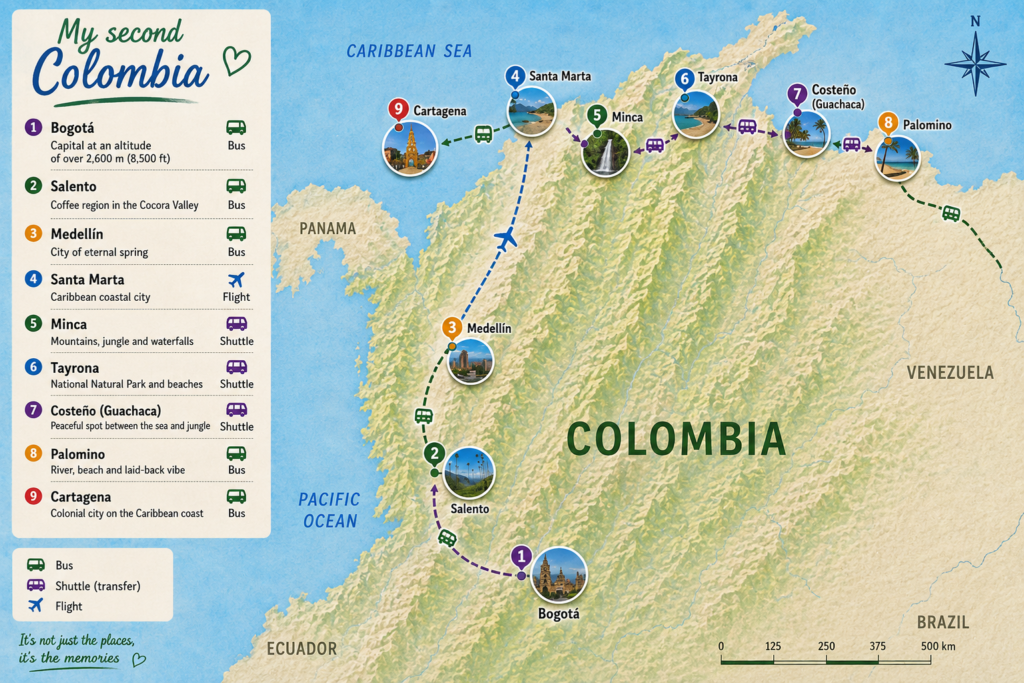
I’ll write more about each place once we’ve actually been there. 🙂
So, how safe is Colombia really?
Colombia definitely isn’t a country we’re heading to quite as carefree as we were when we went to Greece in February. But modern-day Colombia isn’t the Colombia of the 1990s either, even though that image still lives on in films and in many people’s minds.
I’ve read countless accounts from other travellers, travel blogs and official travel advice, and I’ve probably watched hundreds of Reels by now. Based on all of that, Colombia doesn’t strike me as a country I should be afraid to visit. It does, however, seem like a place where we’ll need to be more aware of our surroundings than we would on a typical European holiday.
Shows like Narcos, along with countless films and documentaries, have kept events from 30 or 40 years ago fresh in people’s minds. For many foreigners, Colombia is still automatically associated with Escobar and cocaine.
But Colombia has changed enormously over the past couple of decades. In 2016, the Colombian government signed a historic peace agreement with the FARC, bringing more than half a century of armed conflict with the group to an end. That doesn’t mean the entire country is now equally safe or that crime is no longer an issue. There are still parts of Colombia that tourists are better off avoiding, and in the larger cities, theft and robbery are among the main risks to be aware of. But travelling around Bogotá, Medellín, Salento or Cartagena’s Old Town as a tourist is a very different experience from the Colombia portrayed in Narcos.
A golden rule in Colombia — and probably in plenty of other places across Latin America — is “No dar papaya” (literally, don’t give papaya). What it really means is: don’t make yourself an easy target. Don’t wave an expensive phone around on the street, don’t flash your cash, and don’t leave valuables somewhere they can easily be seen or taken.
Pickpocketing and robbery are still real risks, and walking around with your phone in your hand while following Google Maps isn’t a great idea everywhere. In larger cities, we’ll use app-based transport services whenever possible and try to avoid situations where we find ourselves standing on an unfamiliar street at night looking for a way to get back.
So we’re not going to Colombia thinking there’s nothing to worry about. We’re going knowing that we’ll need to be more alert than we might be in some other countries. At the same time, we don’t want an image shaped by events from decades ago to stop us from discovering what looks like an incredibly fascinating country.
Is Colombia cheap?
For someone from Estonia, accommodation, local food and transport will probably feel quite reasonably priced. But that doesn’t mean everything in Colombia is cheap.
Tourist activities, domestic flights, organised tours and popular destinations can add up quickly. I’ve already booked all of our accommodation for the 41 days we’ll be spending in Colombia, and the average comes to €57 per night. Our cheapest stay is in Bogotá at under €31 per night, while the most expensive is in Minca at €173.
The Minca accommodation is an intentionally expensive choice. There are a lot of frogs in and around Minca, and one of the things I considered when choosing where to stay was how likely I’d be to encounter one in our room.
Excluding our Tallinn–Bogotá flight, we’re estimating a total budget of around €5,800 for the two of us for 41 days in Colombia, which works out at roughly €140 per day. That includes all kinds of activities, national parks, food and drinks, domestic flights and other transport.
Once the trip is over, I’ll be able to tell you whether I was being too optimistic — or whether I gave us far more breathing room than we actually needed.
What draws us to Colombia the most?
Nature.
Wildlife and birds.
The Caribbean Sea.
The mountains.
Smaller places beyond the big cities.
The chance to learn Spanish.
And probably a little bit of the unknown, too. Because if I’m honest, we don’t really know what’s waiting for us yet either.
So why Colombia after all?
The simplest answer to “Why Colombia?” is still that it was the cheapest place for us to fly to.
But that only explains why we bought tickets to Bogotá. It doesn’t explain why we decided to spend more than a month in Colombia.
The more we researched the country, the harder it became to decide what to leave out.
I guess after 41 days, we’ll be able to say whether Colombia lived up to our expectations in real life.