4 Weeks in Greece: Exploring the Peloponnese
This trip was a little different from our usual travels. We wanted to swap a cold and snowy February in Estonia for a month somewhere warmer.
We actually ended up in the Peloponnese almost by accident. In the autumn of 2025, I came across accommodation offered by fellow Estonians in the small village of Chrani. The price for four weeks was so good that I started looking into where exactly Chrani was and what there was to see and do in the Peloponnese.
The more I read about the area, the more I liked the idea. And just like that, a random accommodation deal ended up deciding where we’d spend our next winter escape.
The Peloponnese
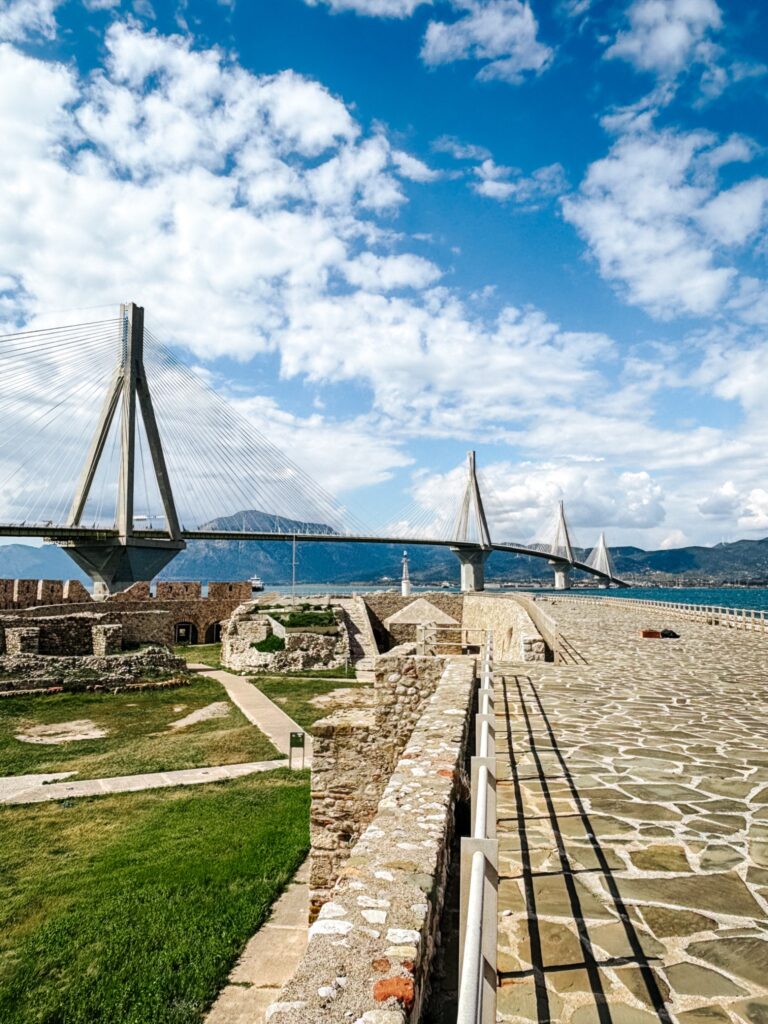
The Peloponnese is a large peninsula in southern Greece, connected to mainland Greece by the narrow Isthmus of Corinth. The Corinth Canal cuts through the isthmus, effectively separating the Peloponnese from mainland Greece.
The region is known for its mountainous landscapes, olive groves, small villages, long coastline and ancient sites. It is home to famous places such as Olympia, Mycenae and Epidaurus, as well as plenty of places that many visitors to Greece never get to see.
Compared with Athens and the popular Greek islands, much of the Peloponnese is noticeably quieter and less touristy. Distances can be surprisingly long, though, and there is a lot to see across the peninsula, which makes it particularly well suited to exploring by car.
If you’re planning a shorter trip, I’ve also put together a 7-day Peloponnese road trip from Athens using three bases instead of staying in one place.
Our base was the small seaside village of Chrani in Messinia, in the southwestern Peloponnese, where we stayed from 19 February until 23 March 2026.
If you’re considering visiting at the same time of year, I’ve also written a separate guide to what the Peloponnese is really like in winter, including the weather, beaches, what stays open and where I’d choose to stay.
Our home for the next four weeks
We chose Elena Bungalows, which was run by Estonians. I had found a couple of other suitable options as well, but the combination of the price and the location right by the sea made Elena Bungalows the clear winner.
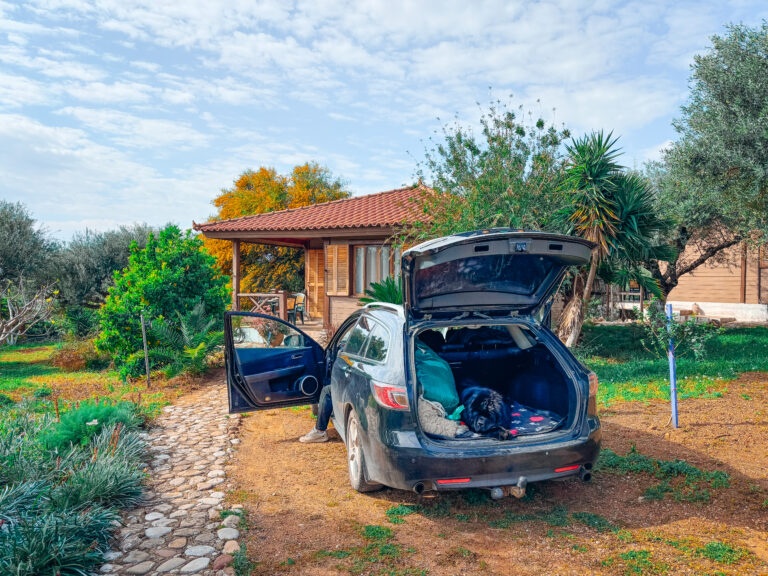
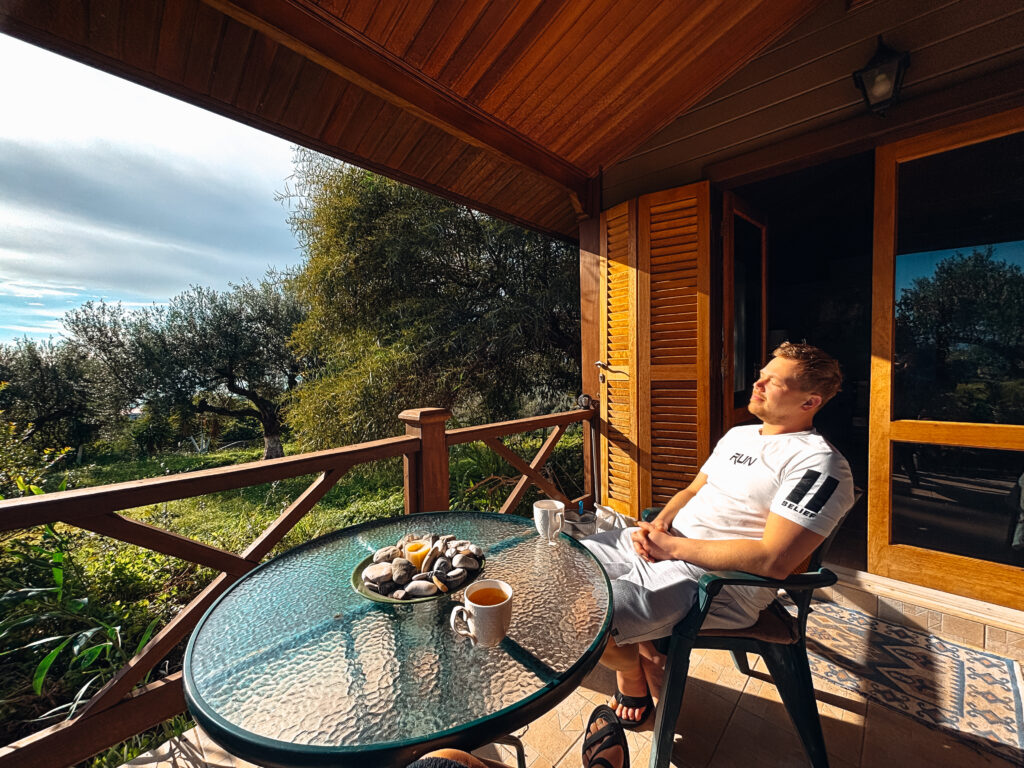
Bungalow number 7 became our home for the next four weeks. It was a cosy 45 m² wooden bungalow with a separate bedroom, an open-plan kitchen and a small terrace. For a stay of this length, it worked perfectly for us.
I can imagine it being especially lovely in summer when beach season is in full swing, as the sandy beach was literally just across the road from the property.
Chrani in winter
Chrani itself is a small seaside village with a few restaurants, a small grocery store and a few other basic amenities. In February, however, most of the village was pretty much asleep for the winter, and we didn’t actually eat out there at all.
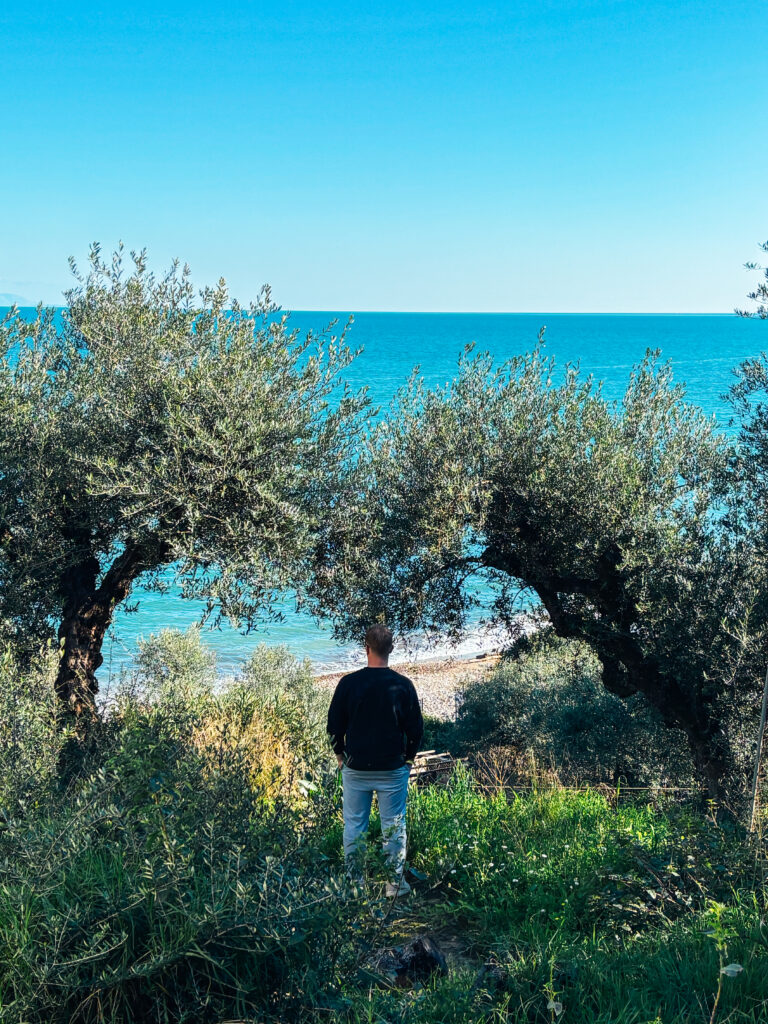
By the second half of March, we could already see the village slowly starting to prepare for the summer season. The beachfront café near our accommodation, for example, was being prepared for the season, even though when we first arrived there had been almost no sign that beach season was approaching.
Whenever we wanted to go out for a meal, we usually drove to Petalidi or Koroni. Both had more going on during the winter, with cafés and restaurants still open.
One thing we developed a slight addiction to during that month was the local oranges. We bought them in five-kilo nets for around €5, and they were incredibly fresh, juicy and delicious. We started squeezing fresh orange juice with breakfast, and after that, the oranges sold back home in Estonia just didn’t seem quite good enough anymore.
What is the Peloponnese like in February and March?
The weather during our stay was quite mixed. We had rainy days, but also plenty of beautiful sunny ones. Some days, the temperature was only around 15°C, but if you found a sheltered spot in the sun, it was actually warm enough to sunbathe. The UV index reached 5 on days like these, and we definitely took advantage of the sunshine a couple of times.
The local Estonians, of course, kept complaining that it was an unusually cold spring and that the weather just refused to warm up.
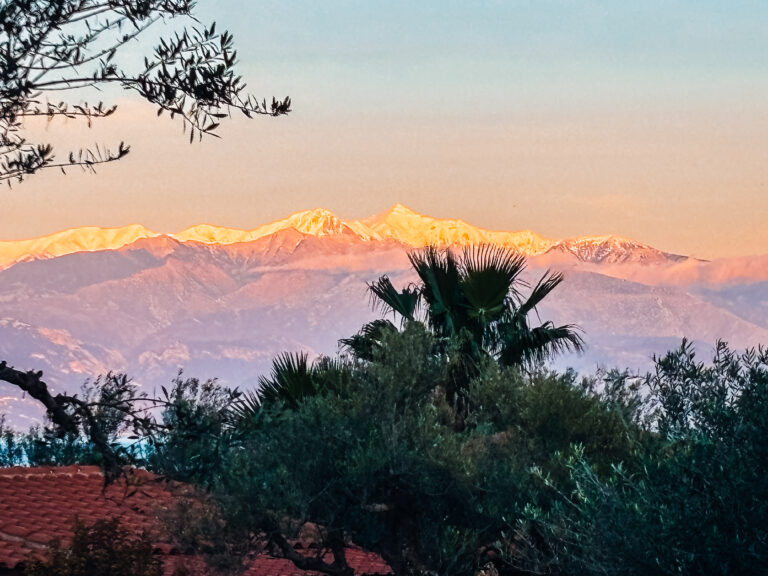
That said, February and March are not the months to come here expecting a proper beach holiday. Evenings were cool, and once we headed into the mountains it was a completely different story – in Kalavryta, winter was still very much alive at the beginning of March.
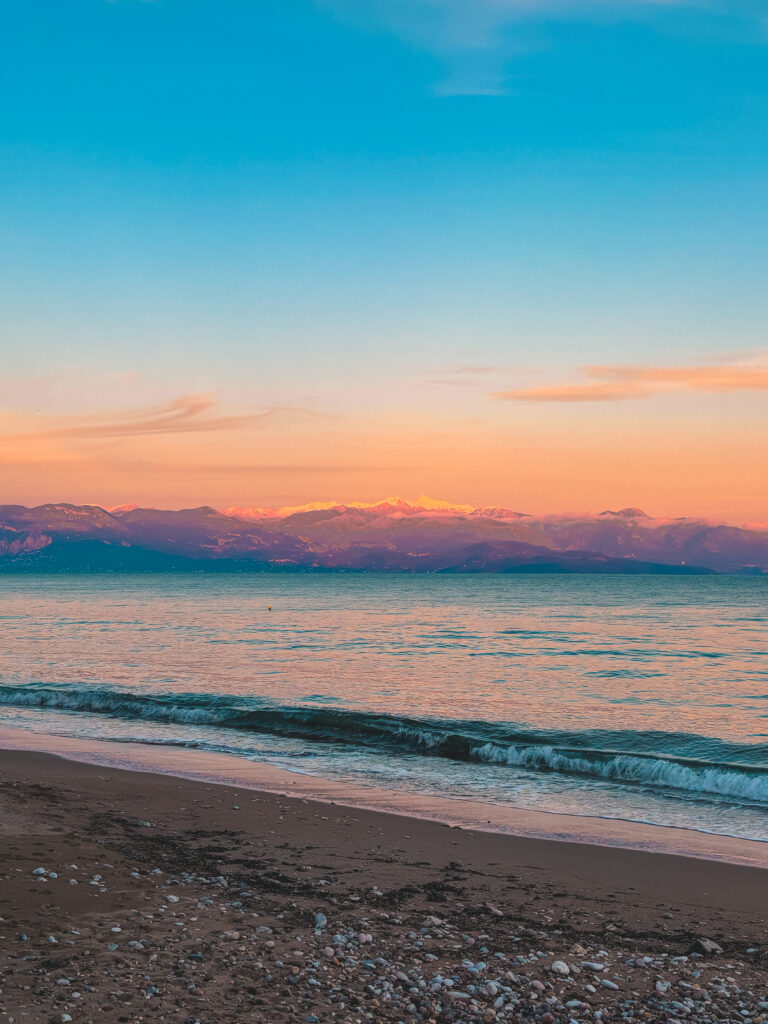
For us, though, simply being able to sit outside on the terrace in the sunshine in the middle of the day already felt like a huge improvement over February back home in Estonia.
Do you need a car in the Peloponnese?
Based on our experience – absolutely.
I honestly can’t imagine how we would have managed in this part of the Peloponnese without a car. It isn’t just that the sights are spread quite far apart. Even simple everyday errands can become inconvenient without one.
The grocery store in Chrani was less than 900 metres from our accommodation, yet even that short trip was often easier and safer by car. There were basically no pavements and the road was winding, so walking along the roadside wasn’t particularly pleasant.
We did walk to the shop a few times, but personally, I wouldn’t want to spend four weeks in the Peloponnese without a car.
New friends and the Estonian community in the Peloponnese
We met quite a few new people within our first few days. There were several small bungalows on the same property as ours, as well as a couple of larger buildings with apartments.
One of the larger buildings was home to an Estonian family with a six-year-old daughter who occasionally came over to visit and attempted, with varying degrees of success, to teach us some Greek. Unfortunately, not much of it stuck.
Before leaving for Greece, I had also contacted Jana and Alfred, who run the Facebook page Reisi Kreekas. With their help, we managed to arrange an appointment at a garage to finally have our car’s wheel bearings replaced.
While the car was being repaired, Jana and Alfred drove us around the peninsula, showed us around and took us out to try Greek food.
24 February – Estonian Independence Day
We knew before leaving Estonia that Estonian Independence Day would fall right in the middle of our trip. And since there was an Estonian community in the area, we came prepared: we brought black rye bread, Baltic sprats and pearl barley with us from Estonia.
We actually ended up celebrating twice with two different groups. First, we joined a gathering of local Estonians organised by Jana and Alfred on the beach opposite our accommodation. Later, we celebrated again with the Estonians staying at Elena Bungalows.
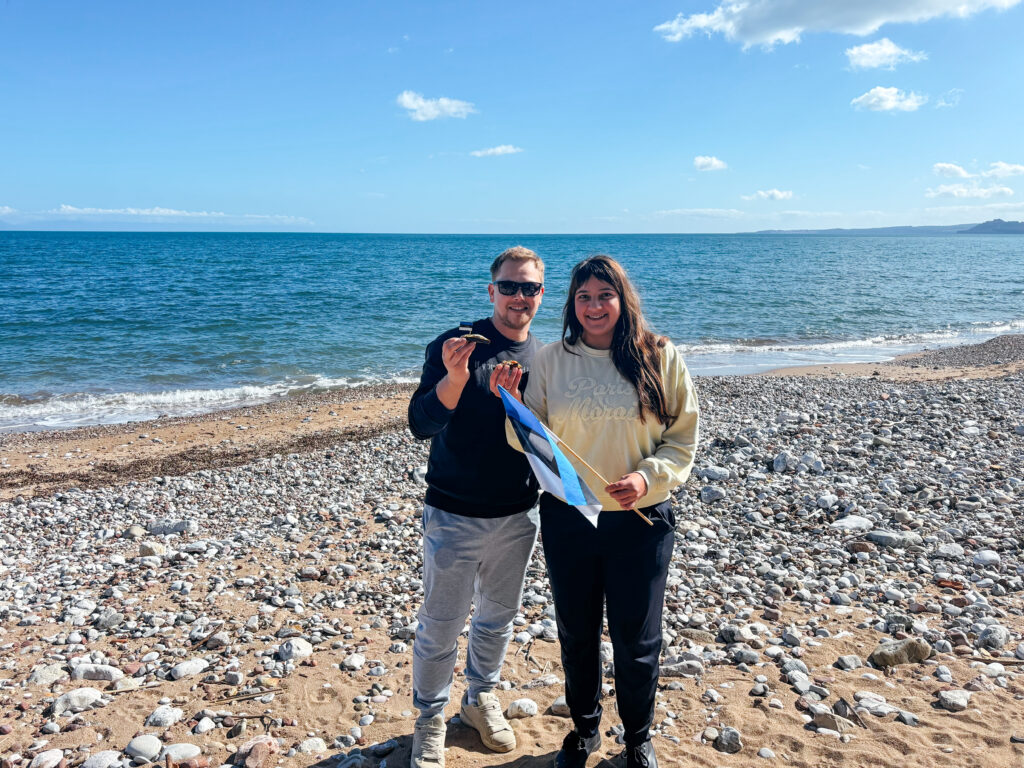
I made mulgipuder, a traditional Estonian dish made with potatoes and pearl barley, while Jana made open-faced sandwiches with sprats, a classic Estonian favourite. Later, back at our accommodation, we had potato salad and küpsisetort, a classic Estonian no-bake layered cake made with biscuits and a creamy filling. Estonian music was playing and it turned into a really lovely evening.
And of course Alice was part of the celebrations too. Greece felt very relaxed when it came to dogs, and we never really had any problems taking her anywhere.
Women’s Day on Bouka Beach
On 8 March, we celebrated International Women’s Day on Bouka Beach with the local Estonian community. There were 12 women altogether – 11 Estonians and one Greek woman whose partner was Estonian.
We had a barbecue and a picnic and simply enjoyed the day. If someone had told me before the trip that I would end up celebrating Women’s Day on a beach in Greece with eleven other Estonian women, I probably wouldn’t have believed them.
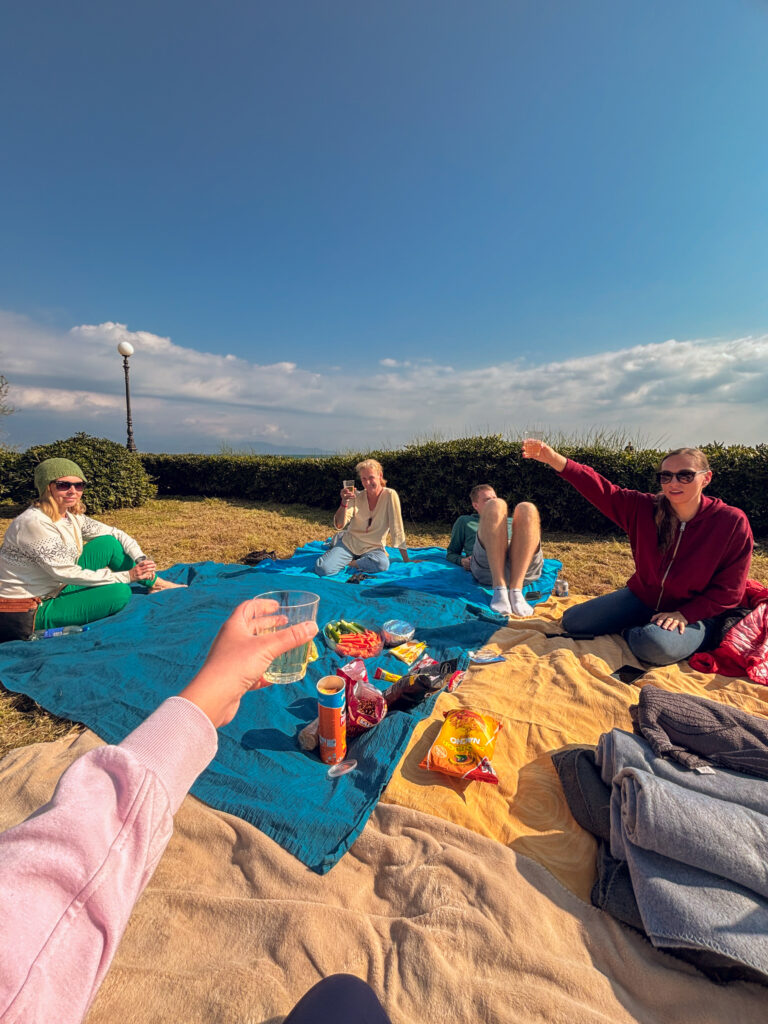
Those unexpected friendships were one of the nicest things about staying in one place for a longer period of time.
How to get to the Peloponnese
We drove to the Peloponnese all the way from Estonia, and just getting there turned into an adventure of its own. I wrote a separate post about our journey, what happened when our car broke down in Poland and how much the entire drive cost: Driving from Estonia to Greece with our dog.
Of course, you don’t have to drive across Europe to visit the Peloponnese.
Kalamata, one of the largest cities in the Peloponnese, has its own international airport, so it is worth checking whether there are seasonal direct flights from your departure point. If not, Athens is usually the easiest option, with a much wider choice of flights. From there, you can rent a car at the airport and continue your journey into the Peloponnese.
Athens Airport was around 285 km from our accommodation in Chrani, and the drive took a little over three hours. We also had friends from Estonia come to visit during our stay, which meant making the journey to Athens Airport twice – once to pick them up and again to take them back.
The Corinth Canal
If you’re driving from Athens to the Peloponnese, the famous Corinth Canal is right along the way and is definitely worth stopping for.
The canal is only around 6.3 km long, but its almost vertical walls reach close to 80 metres in places. What surprised me most, though, was just how narrow it actually is – only around 25 metres wide at water level.
The idea of building a canal here dates back more than 2,500 years, and Roman Emperor Nero even began excavation work in AD 67. The canal was finally completed in 1893.
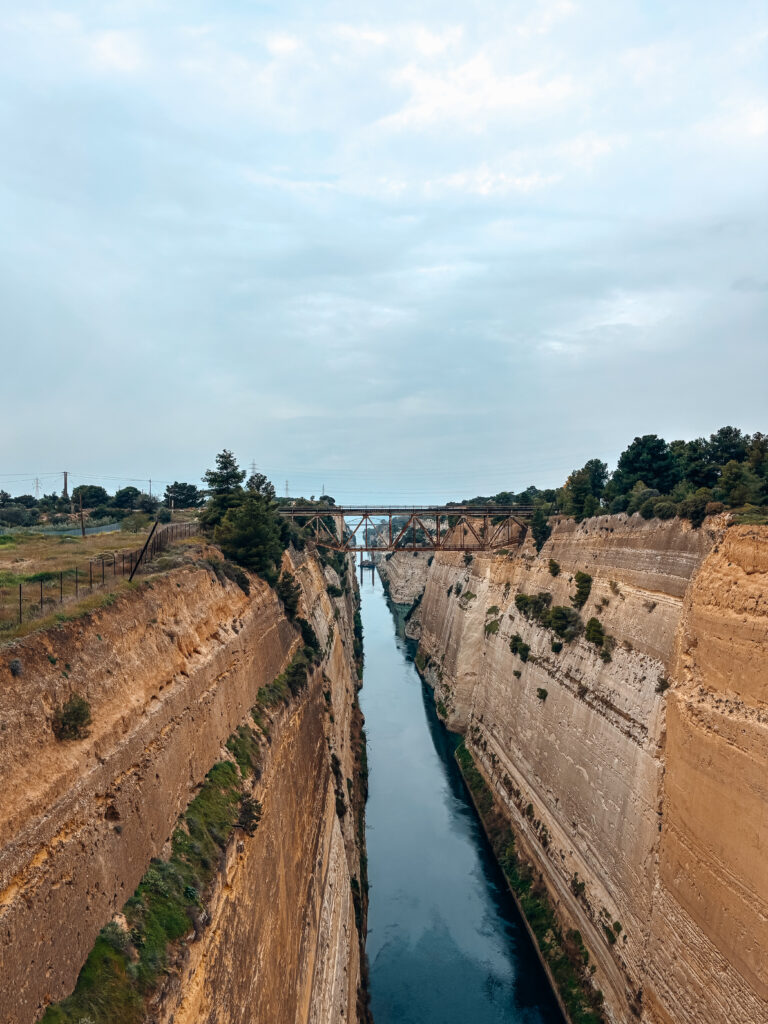
Despite how narrow it is, even cruise ships have passed through it. In 2019, the 195.82-metre-long and 22.52-metre-wide MS Braemar became the largest ship to pass through the Corinth Canal.
With a navigable width of just 24.6 metres at water level, there wasn’t exactly much room for error. The ship was towed through the canal by a tugboat, and there is a pretty impressive video of the whole thing.
Places we visited in the Peloponnese
Even though we stayed much longer than you would on a typical holiday, we still didn’t make it everywhere we had hoped to go. Olympia, Mystras and Monemvasia were all originally on our list, but we ended up leaving them for another time. We did drive to Kyparissia Castle, only to discover that it was unfortunately closed that day.
Nafplio was also recommended to us many times, although it wasn’t originally on our list. At one point we considered going, but quickly realised that if we were going to drive that far, we would want to spend at least an entire weekend there. Rather than spending yet another long day in the car, we decided to leave Nafplio for another trip.
The Peloponnese is simply huge and there is so much to see that even with four weeks to explore, trying to fit in everything isn’t really worth it.
Koroni Castle
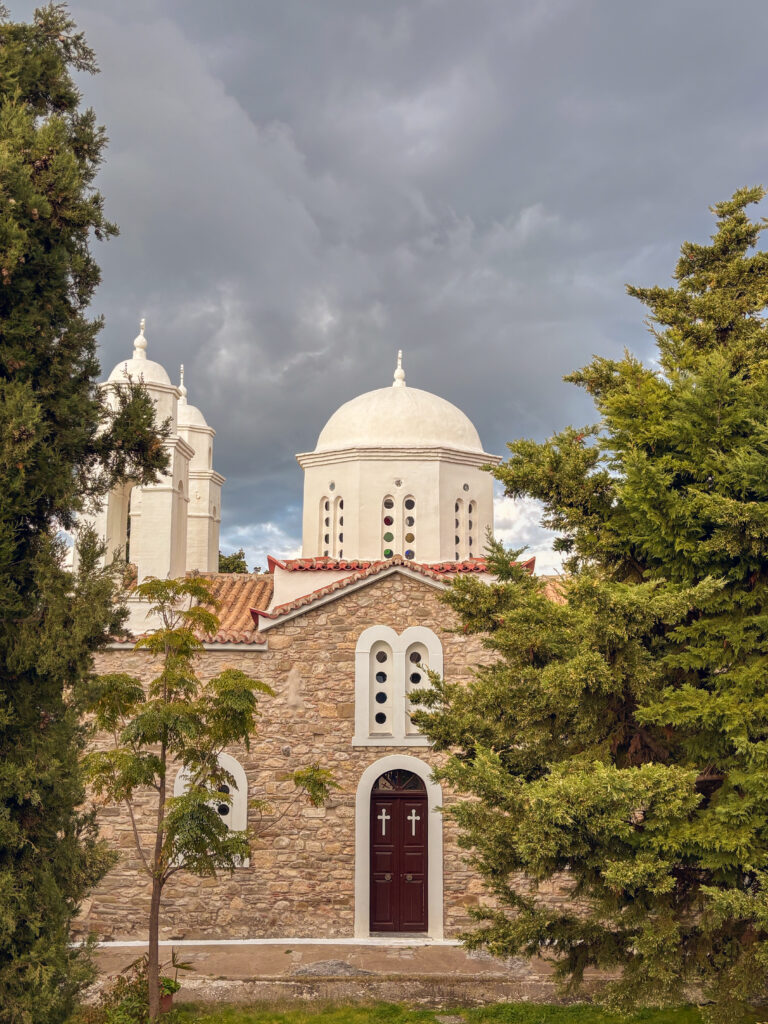
One of the most memorable places we visited was Koroni Castle. For us, it was one of the most romantic seaside fortresses in the area, sitting high above the sea with beautiful views all around.
What makes Koroni Castle particularly unusual is that people still live within its walls, and there is also an active convent inside the fortress. Entry was completely free.
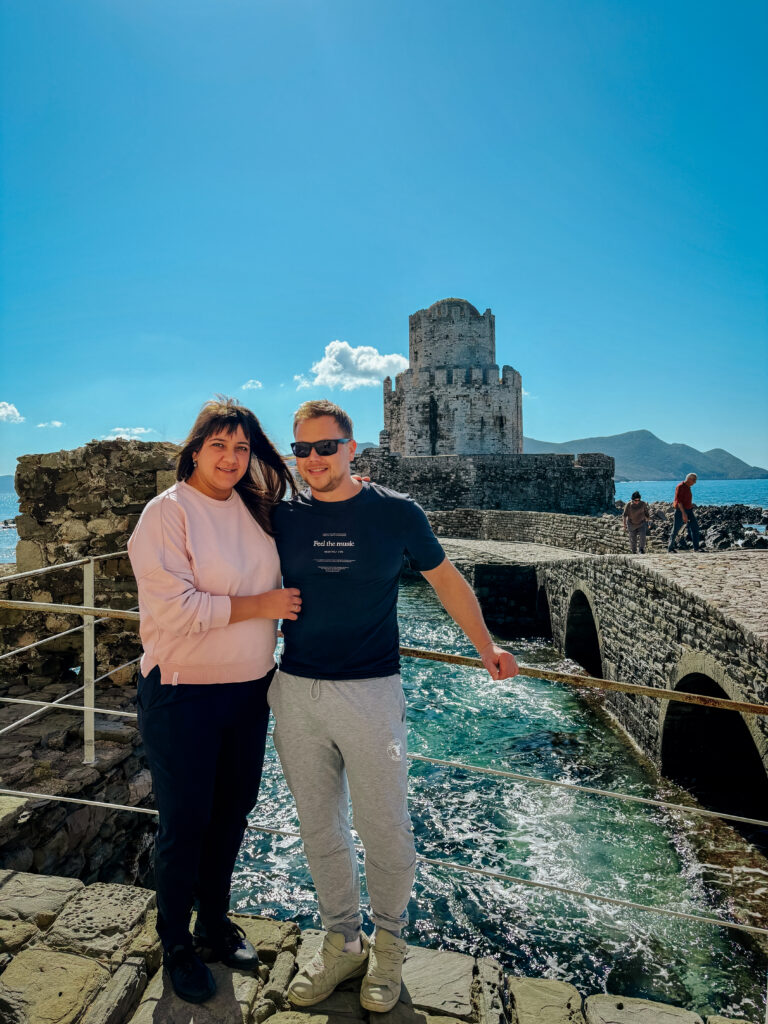
Methoni Castle
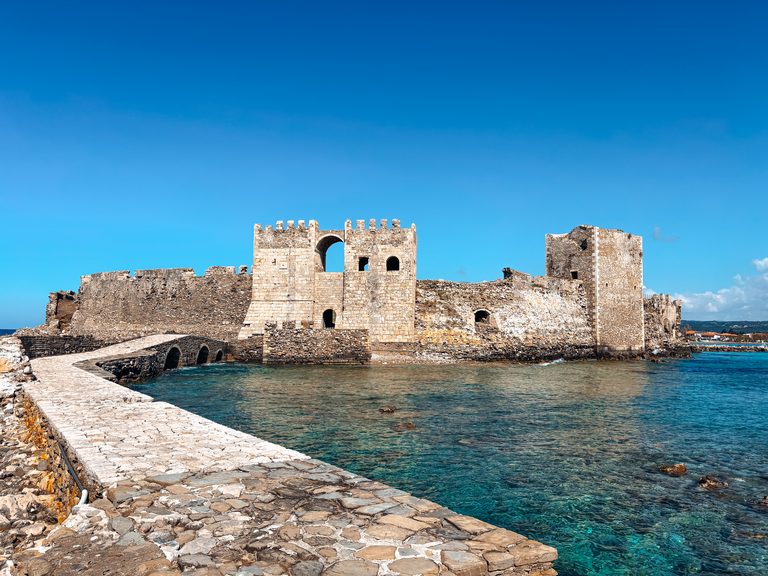
Another place with beautiful views that is definitely worth visiting is Methoni Castle.
It is a huge seaside fortress, and its most recognisable feature is the small octagonal Bourtzi tower, connected to the main castle by a long stone causeway that stretches out into the sea.
When we visited, admission was €5 per adult.
During the Venetian period, Methoni and Koroni were extremely important ports and strongholds along the maritime routes of the eastern Mediterranean.
Old Navarino Fortress and Gialova Lagoon
Old Navarino Fortress was one of Mait’s favourite places. Reaching it meant hiking uphill for about an hour, but the views were worth it.
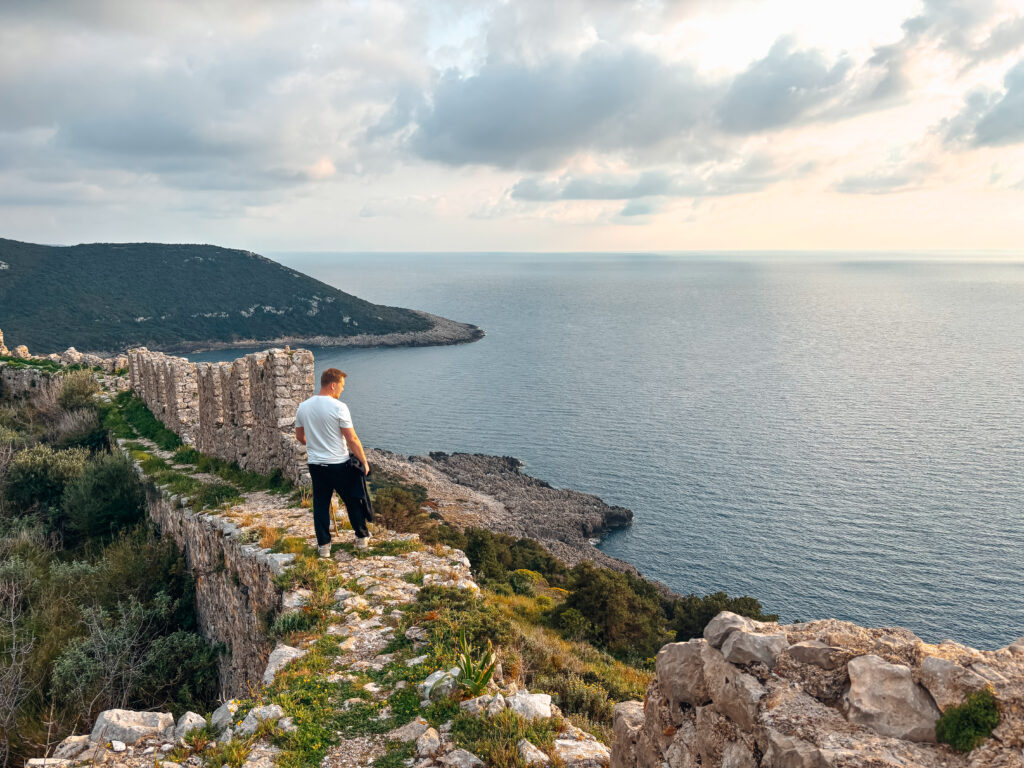
I’m not particularly comfortable with heights, so scrambling around some of the partly ruined sections was genuinely quite scary for me. Mait kept encouraging me to carry on.
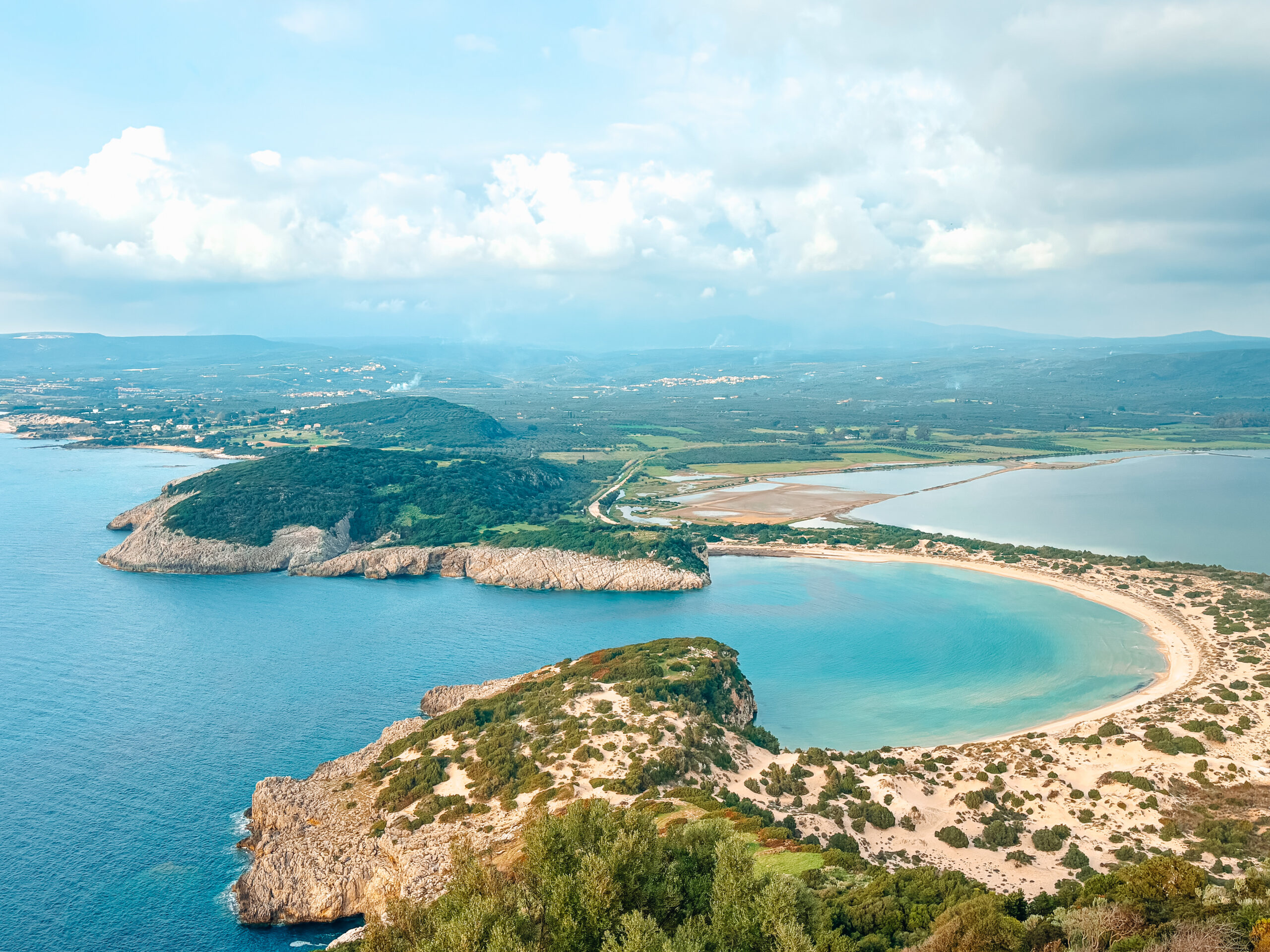
From the top, we had an incredible view over the famous Voidokilia Beach and Gialova Lagoon. If you’re reasonably comfortable with heights, I think the hike is definitely worth doing.
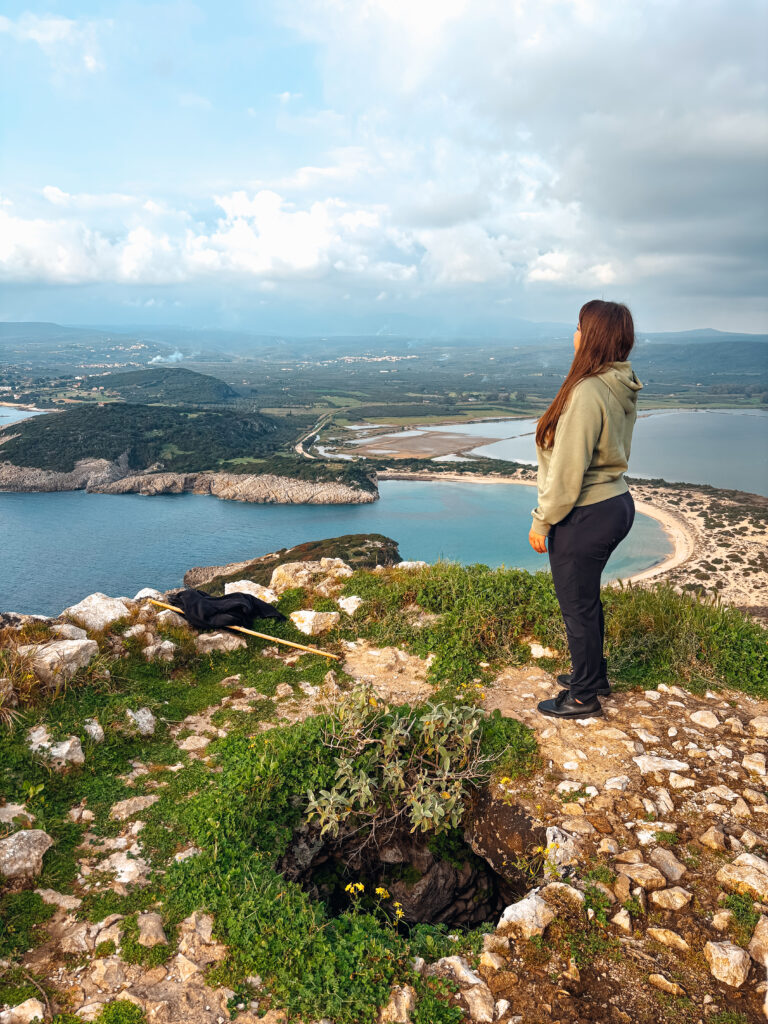
Gialova Lagoon is one of the most important wetlands in the Peloponnese and a well-known birdwatching area. Hundreds of bird species have been recorded there, including herons, cormorants, ducks and many other waterbirds.
We visited in early March and even saw flamingos. Unfortunately, they stayed quite far away. They were easy enough to see with the naked eye, but getting a decent photo of them with a phone was another story.
Polylimnio Waterfalls
I love waterfalls, so naturally there were several on my list.
According to locals, that winter had been unusually cold and wet. The upside was that the waterfalls had plenty of water, but the downside was that some of the roads leading to them were practically impassable.
We were repeatedly told to check the most recent reviews before heading out, especially after rain, to see whether the access road was still manageable. If there was any real doubt, we simply didn’t go.
Polylimnio Waterfalls were only around a 30-minute drive from our accommodation. We actually went twice – once on our own and again when our friends from Estonia came to visit.
The road was much drier the second time, so we were able to drive considerably further. The natural pools there are a beautiful shade of blue, and I can only imagine how nice it must be to cool off in them in summer after scrambling around the rocks.
Kalamaris Waterfall
Since we were already near Gialova Lagoon, we decided to make a small detour to Kalamaris Waterfall as well.
Getting there by car turned into a bit of an adventure. The road was muddy and in pretty poor condition in places, and at one point we did start wondering whether taking our Mazda down there had really been such a great idea.
Then we reached the parking area and met an Austrian family who had driven the exact same road in a motorhome, so clearly our situation could have been worse.
The waterfall itself was impressively tall and, thanks to the wet winter, had plenty of water. Since waterfalls are always high on my list, I was very glad we had made the effort to get there.
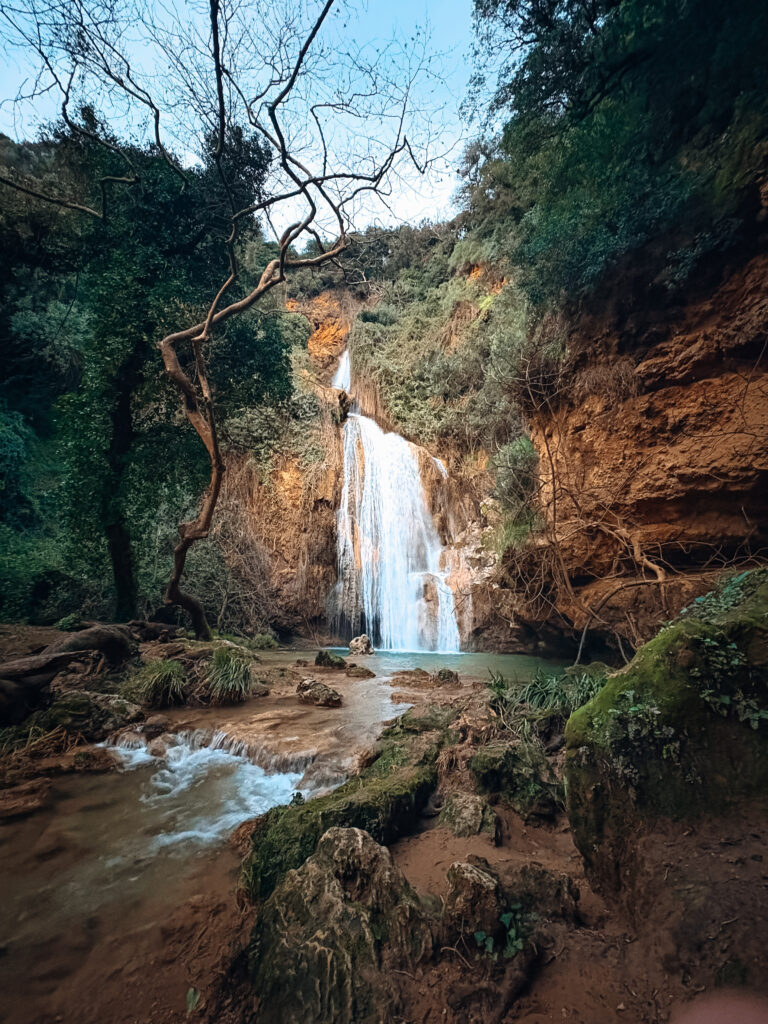
If Gialova Lagoon is already on your itinerary, I think Kalamaris Waterfall is worth considering as it isn’t far away. During a rainy period, though, I would definitely check the road conditions first – getting there by car wasn’t particularly easy when we visited.
Kalamata and the local market
Kalamata was the nearest larger city to where we were staying, so we ended up there several times during our stay.
We also visited Kalamata Castle, which has views over the city and surrounding area, but to be completely honest, there were plenty of places elsewhere in the Peloponnese that we found much more interesting. If your time is limited, Kalamata itself wouldn’t be particularly high on my sightseeing list.
One thing people kept telling us about, though, was Kalamata’s local market. We are really not market people at all, but after hearing so much about it from locals, we decided we should at least go and have a look. In the end, we went more than once.
Every Wednesday and Saturday, Kalamata Central Market hosts a huge local food market with more than 450 producers and vendors. You’ll find an enormous selection of fresh fruit and vegetables, fish and seafood, meat, cheese, olives, honey, herbs and other local products.
Even if markets aren’t really your thing, it is a good place to get a glimpse of everyday local life. It certainly wasn’t one of the highlights of our trip, but because we were staying in the area for over a month, visiting the market somehow felt like part of the experience.
Ancient Messene
One day we also visited Ancient Messene, one of the largest and best-preserved archaeological sites in the Peloponnese. The remains of an entire ancient city can still be seen there, including a theatre, stadium, temples and other structures.
To be honest, ancient ruins aren’t really our thing, which is probably why Ancient Messene completely slipped my mind when I first started writing this post. But if this kind of place interests you, it is definitely worth visiting. The site is huge and you could easily spend several hours walking around.
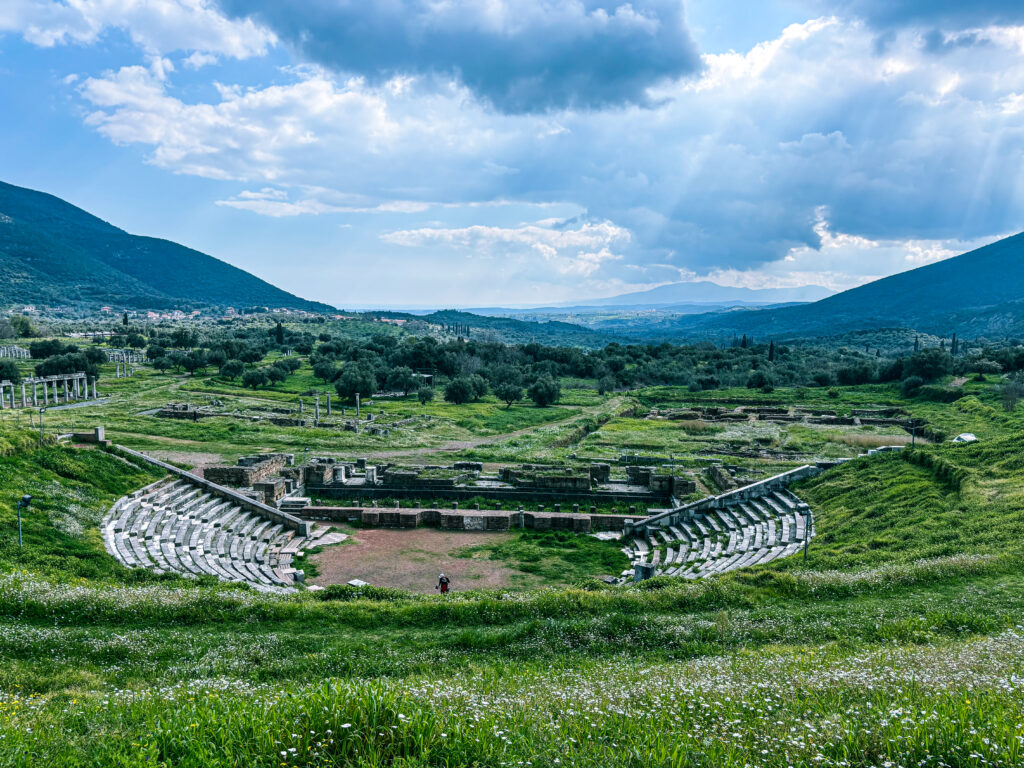
We happened to visit on the right day and got in for free. From 1 November until 31 March, admission to state-run archaeological sites, monuments and museums in Greece is free for everyone on the first and third Sunday of each month.
If you’re travelling during the winter season, this is definitely worth keeping in mind when planning your itinerary.
Visiting Ktima Palivou winery
One of our favourite experiences of the trip was visiting Ktima Palivou.
We learned about the different grape varieties grown in the region and were shown how the wine is made. We also saw where the wines are stored and aged, which gave us a pretty good overview of the whole process.
The visit ended with a tasting. We tried five different wines, and the whole experience was informative without turning into a long or overly serious lecture.
At the time of our visit, the tour and tasting of five wines cost €15 per person, which we thought was very reasonable for the experience.
If you have even a passing interest in wine, I would definitely consider including a winery visit in your Peloponnese itinerary. This was one of those places we would happily visit again.
An Eiffel Tower in the middle of the Peloponnese
One of the more unusual sights we came across was a 26-metre-high replica of the Eiffel Tower in Filiatra.
The tower was built in 1960 by Charalambos Fournarakis, a doctor and sculptor originally from Filiatra. The design was intended to follow the proportions of the original Eiffel Tower in Paris. It was renovated in 2007 and has since become one of Filiatra’s local landmarks.
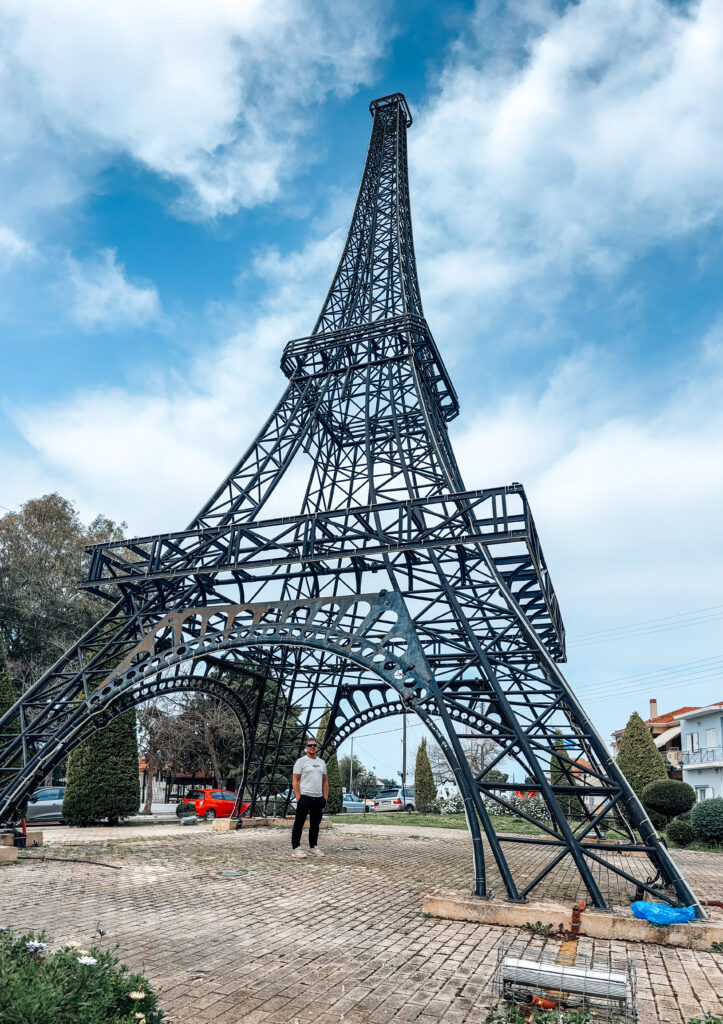
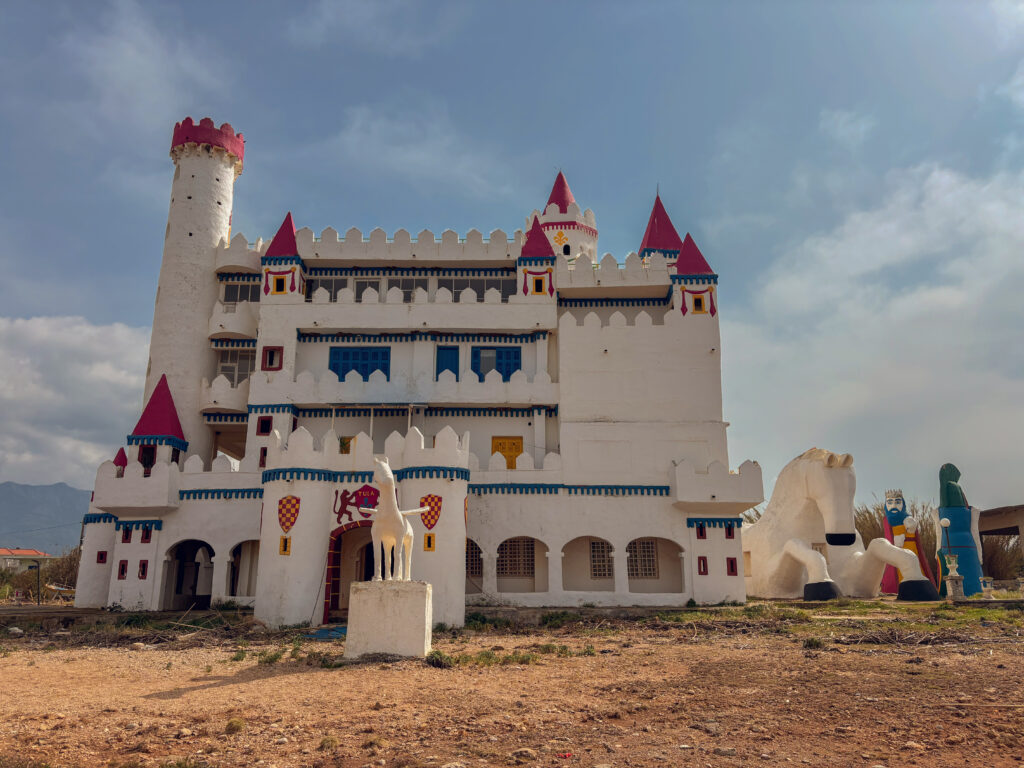
To make the story even stranger, the Eiffel Tower wasn’t Fournarakis’ only unusual idea. A few kilometres away, in the village of Agrilis, he also had a Fairytale Castle built.
So if you ever feel like seeing Greece, Paris and something vaguely resembling a Disney castle all in the same day, apparently the Peloponnese has you covered.
A day trip to Kalavryta
One day we set off for the mountain town of Kalavryta.
We had actually considered staying overnight, but at the last minute we couldn’t find suitable dog-friendly accommodation. So we decided to leave in the morning and drive back the same evening.
Cave of the Lakes in Kastria
On the way from Chrani to Kalavryta, we stopped at the Cave of the Lakes in Kastria, which turned out to be one of the most interesting stops of the day.
What makes the cave unusual is a series of underground lakes on different levels. Over thousands of years, water has created a tiered system of lakes, and during wetter periods it flows from one level to another in small waterfalls.
Walkways and bridges have been built through the cave, allowing visitors to walk among the stalactites and stalagmites.
When we visited, entry cost €9 per person and included a guided tour. Unfortunately, our guide only spoke Greek. Luckily, we were given an English-language brochure, so while the guide was speaking, we could read about what we were looking at and how the cave had formed.
A slightly unusual arrangement, but it didn’t really bother us. The cave itself was interesting enough that we were very glad we had stopped there.
Human and animal remains have also been discovered in the cave, showing that people were using it as far back as prehistoric times. The full cave system stretches for several kilometres, although only part of it is open to visitors.
If you’re driving through the Peloponnese towards Kalavryta, the Cave of the Lakes is definitely worth the detour.
Kalavryta
Kalavryta is a small mountain town in the northern Peloponnese, but there is a surprising amount to see and do there.
Even the drive there felt completely different from the coastal parts of the Peloponnese. At the beginning of March, the road itself was perfectly fine and we had no problems with our all-season tyres, but the higher we climbed, the clearer it became that winter was still very much present.
We were definitely glad to have our spring jackets with us in Kalavryta.
In winter, Kalavryta is one of Greece’s better-known ski destinations. The ski resort on Mount Helmos is around 15 km from town. Mait would have loved to take the opportunity to go snowboarding in Greece, but with only one day in Kalavryta, there simply wasn’t enough time to fit everything in.
Kalavryta is also famous for the historic Odontotos rack railway, which connects the town with Diakopto on the coast and runs through the Vouraikos Gorge.
The roughly 22-kilometre route opened in 1896, and the journey through the mountains and gorge is considered one of the area’s attractions.
We considered taking the train as well, but with the winter timetable, one of us would have had to skip the train ride and drive to the other end to pick everyone up. So we skipped the train and explored the area by car instead.
Kalavryta also has a much darker side to its history. On 13 December 1943, German occupation forces executed hundreds of men and older boys from Kalavryta and burned much of the town.
Today, a memorial to the victims stands on the hillside above the town, and we visited it during our trip. The former school building where women and children were locked inside during the massacre now houses the Municipal Museum of the Kalavryta Holocaust.
The clock on the town’s cathedral remains stopped at 2:34, in memory of the events of 1943.
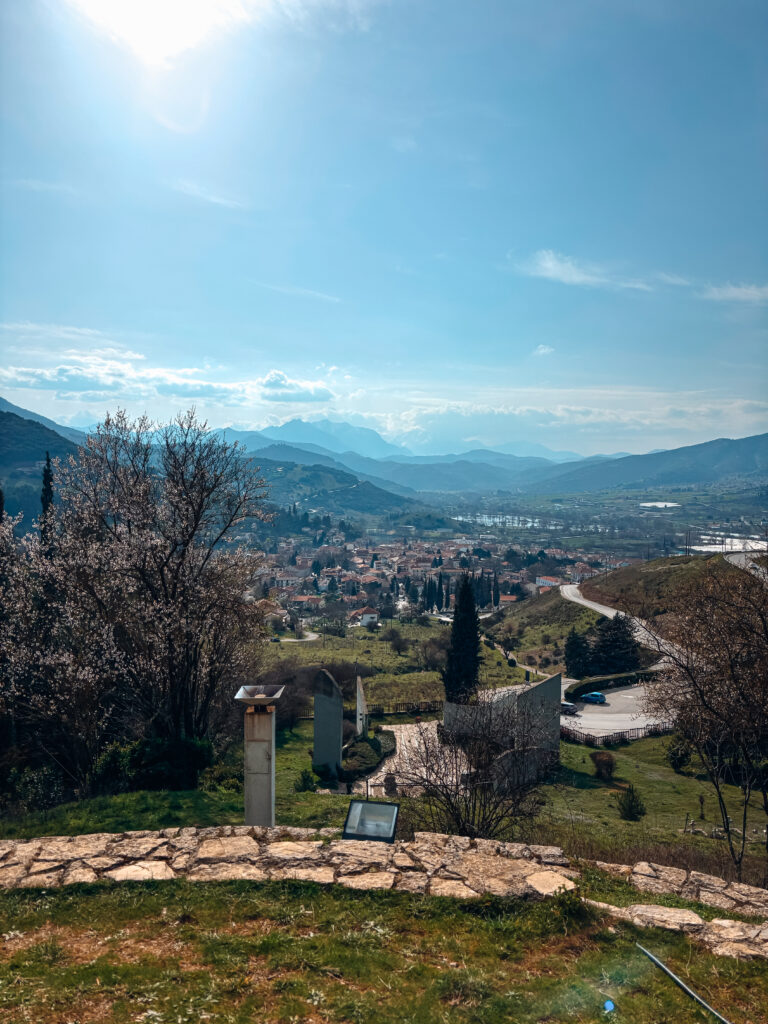
After visiting the memorial, we spent some time simply walking around the streets of Kalavryta. The town itself felt pleasantly small and quiet in winter, and of course we had to try some of the local food.
Wild boar is fairly common on menus in this mountainous part of Greece, so naturally we tried it. We also bought some wild boar sausages to grill later, which turned out to be really good. In hindsight, we probably should have bought more.
Petalidi and a very happy Alice
A couple of times we drove from Chrani to nearby Petalidi. It was a slightly larger village with a central square, a school and a church, as well as several shops and places to eat.
There was also a pleasant waterfront promenade where we could walk with Alice.
By this point Alice was already old and couldn’t manage long walks anymore, so most of the time we simply walked with her around our accommodation.
The waves on our local beach in Chrani were quite strong, though, and Alice seemed reluctant to go into the water because of them. Newfoundlands are practically built to charge into the sea, and when she was younger the waves wouldn’t have bothered her at all. But as she got older, she had apparently learned to be a little more careful.
So one day we took her for a longer walk along Petalidi’s waterfront and found a calmer spot where she finally went for a swim.
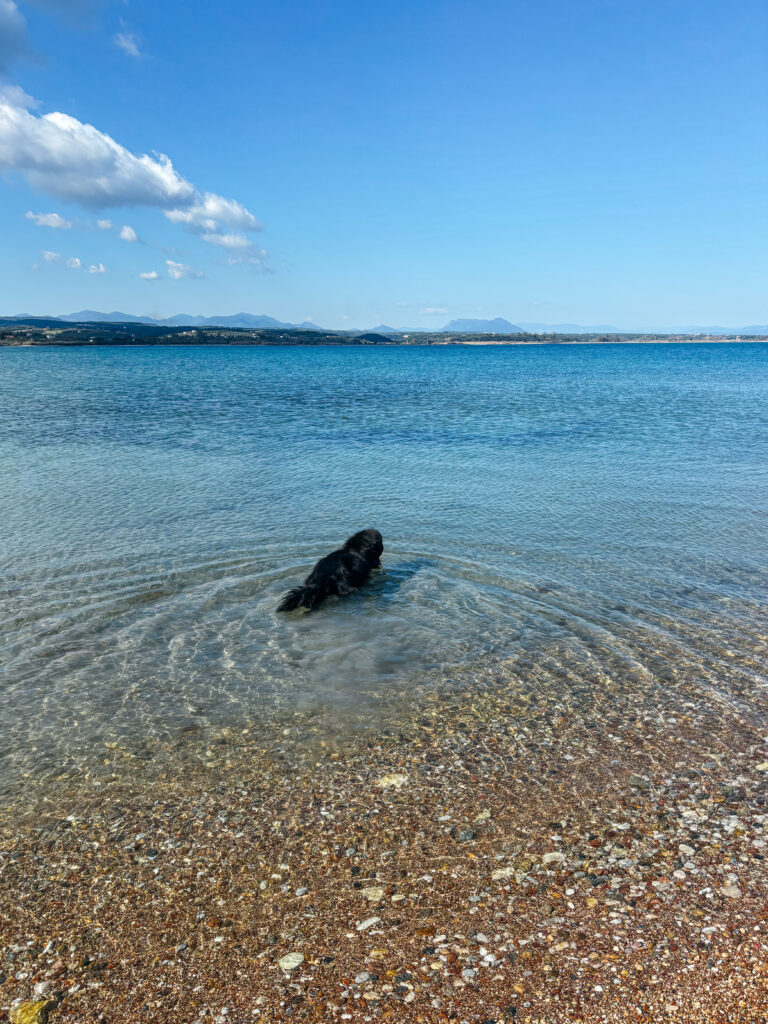
I did feel slightly bad that we’d left her life jacket at home, but there was no doubt she was thoroughly enjoying herself.
How much did four weeks in the Peloponnese cost?
Since we spent more than four weeks in the Peloponnese, I thought it would be interesting to go through our bank statements afterwards and work out how much we had actually spent.
For this breakdown, I counted the period from 20 February to 22 March – 31 days in total. The cost of driving from Estonia to Greece and our Europe road trip from Greece back to Estonia are not included.
| Expense | Cost |
|---|---|
| Elena Bungalows accommodation | €660 |
| Groceries and everyday purchases | ~€1,100 |
| Restaurants, cafés and activities | ~€1,030 |
| Fuel | ~€446 |
| Tolls | ~€81 |
| Parking | €6 |
| Car repair – wheel bearings | €323 |
| Clothes, cosmetics and other personal purchases | ~€136 |
| Cash withdrawal fees | €26.75 |
| Total | ~€3,809 |
That works out at around €123 per day for two people, or €61.50 per person per day.
The total also includes an unexpected €323 car repair. Without that, our spending for the four weeks would have been around €3,486, or €112 per day for two people.
It is also worth keeping in mind that our fuel and toll costs were higher than they would be for many travellers. We had friends visiting from Estonia and drove the Chrani–Athens Airport–Chrani route twice – once to pick them up and once to take them back to the airport.
So I wouldn’t consider our combined €527 in fuel and tolls a typical transport budget for four weeks in the Peloponnese.
Grocery prices generally felt fairly similar to Estonia. Some things were more expensive and others cheaper, but overall we didn’t notice a dramatic difference.
Local wine, on the other hand, was very cheap. A 1.5-litre plastic bottle of local wine cost less than €3. And as I mentioned earlier, we also went through quite a lot of oranges – a five-kilo net cost around €5.
We had brought Alice’s food with us from Estonia, so her food isn’t included in this budget and we didn’t need to buy any additional dog food during the trip.
Would we return to the Peloponnese?
I definitely would.
I actually think winter is a great time to travel around and explore the Peloponnese. There are far fewer tourists, the heat isn’t exhausting, and you can take your time at popular places without crowds.
You just have to be prepared for very changeable weather and accept that some seaside towns are pretty quiet outside the main season.
There is one thing I do regret – I never actually managed to swim in the Mediterranean. I did dip my feet in the water, and Alice had her swim, but it was still too cold for me.
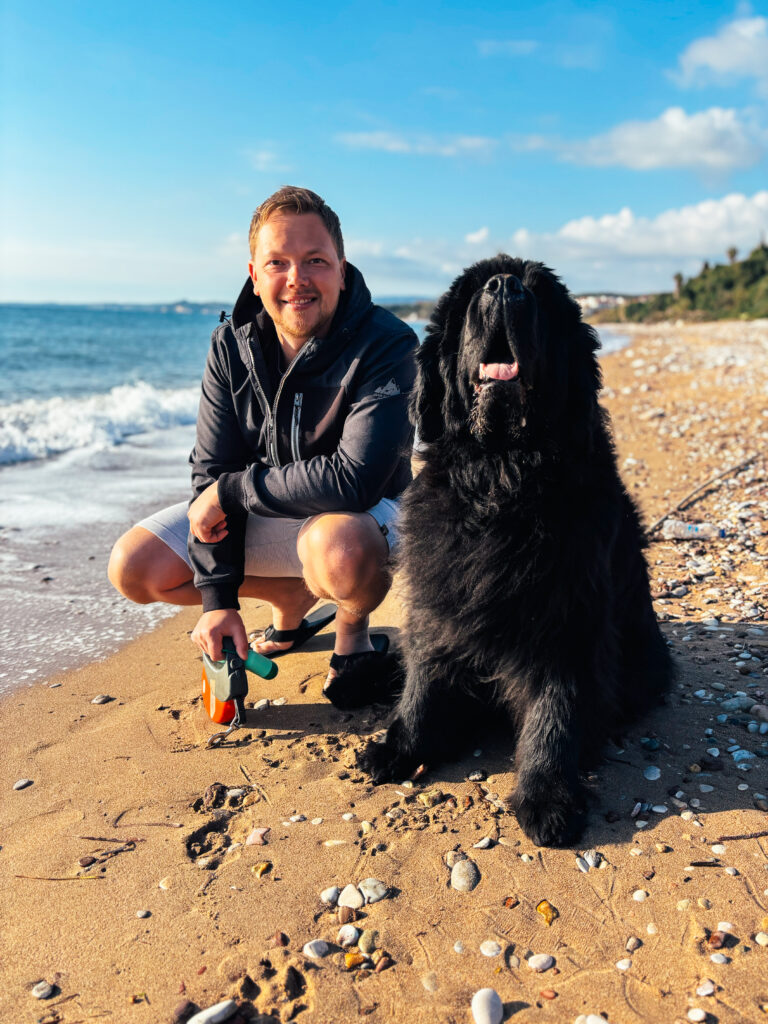
I would definitely consider coming back in autumn, though. By then, the intense summer heat has eased, the sea is still warm and plenty of local fruit is in season. After our experience with those oranges, that alone sounds like a fairly good reason to return.
Personally, I probably wouldn’t choose the hottest part of summer. As an Estonian, I prefer temperatures that feel a little more manageable, and if the plan is to do more than just lie on the beach – driving around, hiking, climbing around old fortresses and exploring different places – spring, autumn or even winter sounds much more appealing to me.
We originally came to the Peloponnese simply to escape the Estonian winter for a month.
By the time we left, it felt like we had seen an enormous amount and yet somehow still had a long list of places left for next time.
And I think that’s a pretty good sign when it comes to a travel destination.
Our month in the Peloponnese was only one part of the journey. After leaving Greece, we continued our Europe road trip through Albania and Italy before driving back to Estonia.
If you’re planning your own trip to Greece or want to see what else we got up to during this journey, you can find all of our Greece travel stories here.